The truth is, I have never given up my pencil. With it in hand, I slip into the tactile world of music. I love the scratch of the point, sometimes breaking with a pop, the smooth finish of the staff paper, and the slide of the eraser. Sometimes, I lean in hard with feeling, pressing almost through the paper. Later, my fingers brush over the marks on the back side of the page, and as if reading them like a secret code.
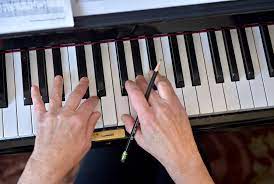 This sensitivity to touch comes from decades as a pianist; my fingertips can almost see at touch. The act of playing music on a piano is about bending the bones of my fingers – meeting music with my flesh – moving into and through to mold, bend, scoop it out of the ivories. This finger work, whether at the piano or grasping a pencil, sees and smells independently of myself.
But there is another reason I compose with pencil; the freedom it gives me to create. The page is a tabula rasa, open and waiting to be filled.
In my first draft, notes drift around, sometime clumping together or jumping lines. Page after page I scribble here and there, crossing out, or drawing arrows to another section. Pages waft to the floor or slide on top of the piano; a sea of notes. I am full of motion as I compose, using a kinetic energy that brings out a sweet solidity. I swear that my hand, moving up and down, over and across as I compose with pencil, wakes up a deeper something else. It moves me into the heart of things.
By the second draft, I have decided the order of the sections, and crafted each transition. Only when I have put the whole piece together in pencil do I turn to my computer, my typewriter.
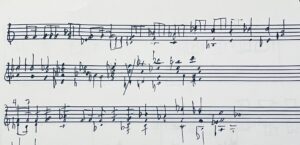 A music notation program, no matter how brilliant, is a box in which I fit my music. They are created based on classical music or even programmers’ ideas, and lag far behind living composers who challenge perceptions and create new ways of communicating music. It has to catch up to me, not the other way around.
If I am not careful, the limitation and inflexibilities of a software program can impact my composing process and even my thinking. Sneakily, it defaults to a notation I don’t want to use. Fortunately, I have already settled the argument with my pencil, so I insist. The program fights back, and we wrestle back and forth until I find a workaround, or use a prompt to override it.
I find it exhausting resisting this steady pull to the middle that is not my own. But with my score already rendered in pencil, I am fully armed and ready to push against the software and avoid the influence of its’ overbearing hand.
It is the first day of my composition class for the music majors at Franklin and Marshall College. I have just informed them that they are not allowed to use their computers for the first six weeks of the semester. A look of confusion flashes over their faces, then concern. “What do you mean?” asks one student, “We have to use a pencil? And compose music on staff paper?”
I smile. The start is an open field to explore.