• Skip to main content
  • Skip to footer

Tina Davidson

Composer

  • About
    • Biography
    • Community Engagement
  • Press
    • Press
    • Interviews & Podcasts
  • Works
    • Works
    • Listen
    • Recordings
    • Publications
  • Blog
  • Contact

women in the arts

Bleached Thread, Sister Thread

December 5, 2022 by Tina Davidson

for string quartet

June 28

Cody, Wyoming, the first afternoon, is dark and overcast. At night, I cannot see the full moon. But today is blue and so bright; the mountains are clear and tremendous. As I walk, I am reminded of other spastel, in the gardenolitary walks and weeping landscapes – green, green, meadows and black grey skies.
The new work I am hearing is different. I feel its weight and am reluctant to take up the responsibility. Bleached Thread, Sister Thread, commissioned for the Mendelssohn Quartet, takes the title from one of my sister’s, Eva Davidson, poems. These are old issues; sister bonds, attachments, and delicate fine stuff – a sense of joy and release.

Gratitude reappears in my mind. I find it difficult to accept gifts without payment. So used to a bad turn, a broken heart, it is almost beyond my understanding to accept the gift of returned health without sacrifice. Pain has always defined me. Will gratitude now make me one of them? One of whom?

Opening one’s self to grace.

 July 15

I begin to hear.  Quietly, and with bursts of light, a song emerges out of rubbing – a soft shuddering

          what was gathered or what was learned;

          and now you and I will tell each other

          what we know, that to be distant

         is sometimes closer than to be near. (1)

September 16

The shape of the quartet keeps changing. In this piece, I am guided more by the material than the form. There is a dark black energy in my stomach. Despite the clear, calm weather, the days are unsure.

At first I was conflicted over the work moving a direction I had not planned. But when I viewed the construction with curiosity instead of tension, the work reveals itself. The energy of the music is fierce in its optimism, constantly moving forward and changing. I feel the animation of health restored, of a future fullness refreshed.

Yet, still, still – a disconnection. Despite the celebration, a fracture in my life shows itself. The piece ends in a deep sadness. I cannot control this; I only allow what is.


Excerpted from Let Your Heart Be Broken, Life and Music from a Classical Composer by Tina Davidson.  © Tina Davidson, 2022

(1) excerpt from Bleached Thread, Sister Thread, poem by Eva Davidson

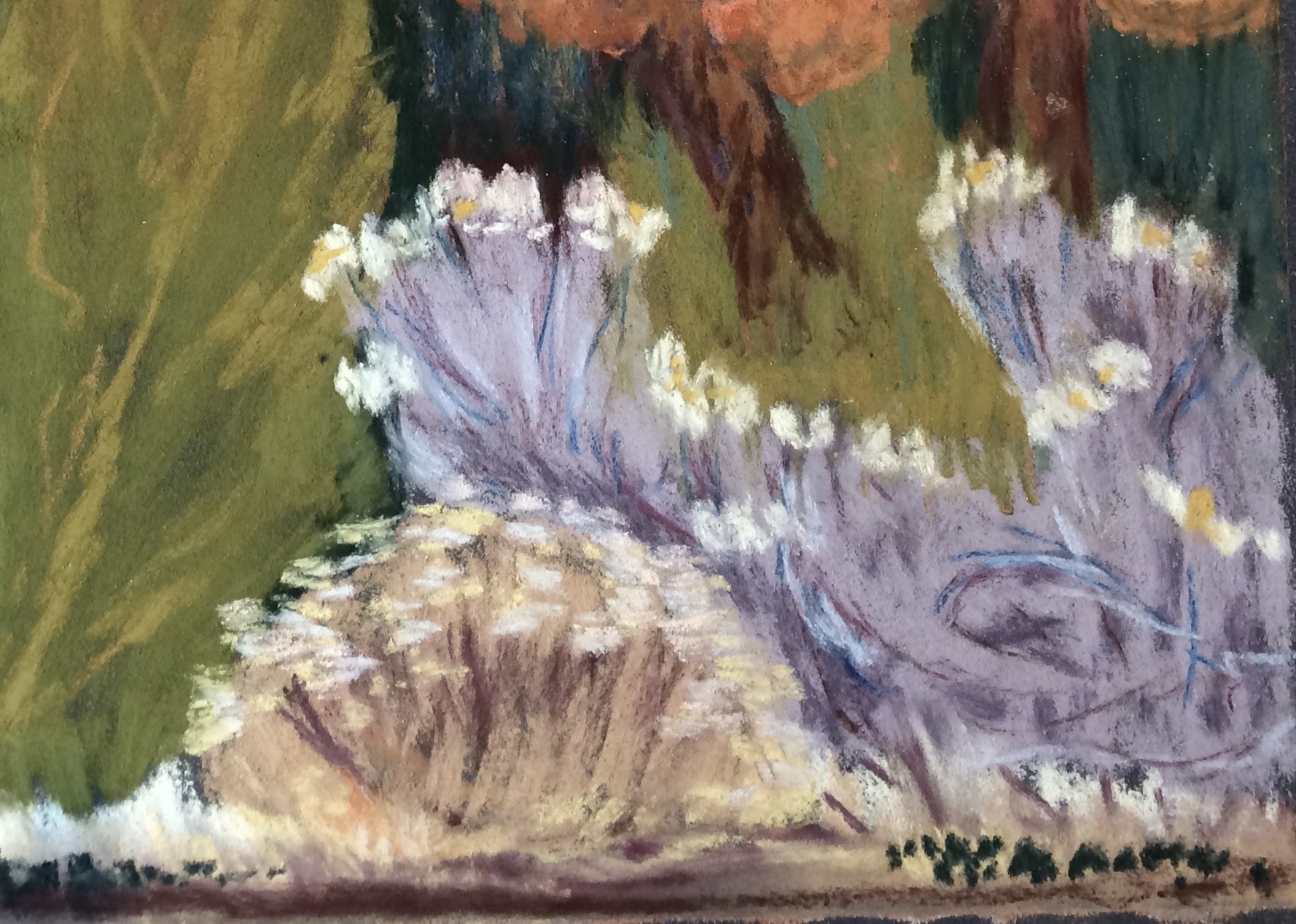
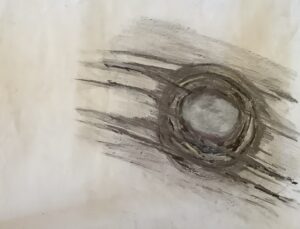
In the Garden, pastel by Tina Davidson


Filed Under: Uncategorized Tagged With: comsing music, creative process, music journal, process of composing, string quartet, thoughts about musical composition, Tina Davidson, women composers, women in the arts, writing about music

Random Thoughts #5

November 7, 2022 by Tina Davidson

Notes from my Journal

 April 6

I am in between a state of reluctance and anticipation. I can “hear” the new work better than I can understand it, something about mountains, fires, sexuality and the dark pounding of the heart.

March 31

“What is the relationship between artists and their work?” a friend asks.

I can only speak of my landscape – to economize my life so that I am available. Not as an act of abstinence or poverty, instead, of allowing. When my life is work centered, all else falls off. I am at the essence of my life. The choice is time, energy and clarity. The rest – family, friends, fun – falls into place naturally.

Being available is an act of love I give myself, for here is where my spirit lives. As I go out in my work, it is all me, and at the same time, not me. When my work connects with others, my face becomes many faces, both anonymous and personal, both unrecognizable and identifiable.

The risk of art is to be at the edge of selfishness, which seems to be vanity, but is not. Vanity keeps me separate and elevated from others. Art grovels in the same mud, but ascends.

For today, I ask what my work needs and thereby know how to live my life. Letting the non-essentials go, I keep the treasures. The rest flows from me like fall leaves tossed on the river stream, riding the current happily away from me. The love I put into my work is the same that pours into my life, family, and community. A source that renews itself continually.

October 9

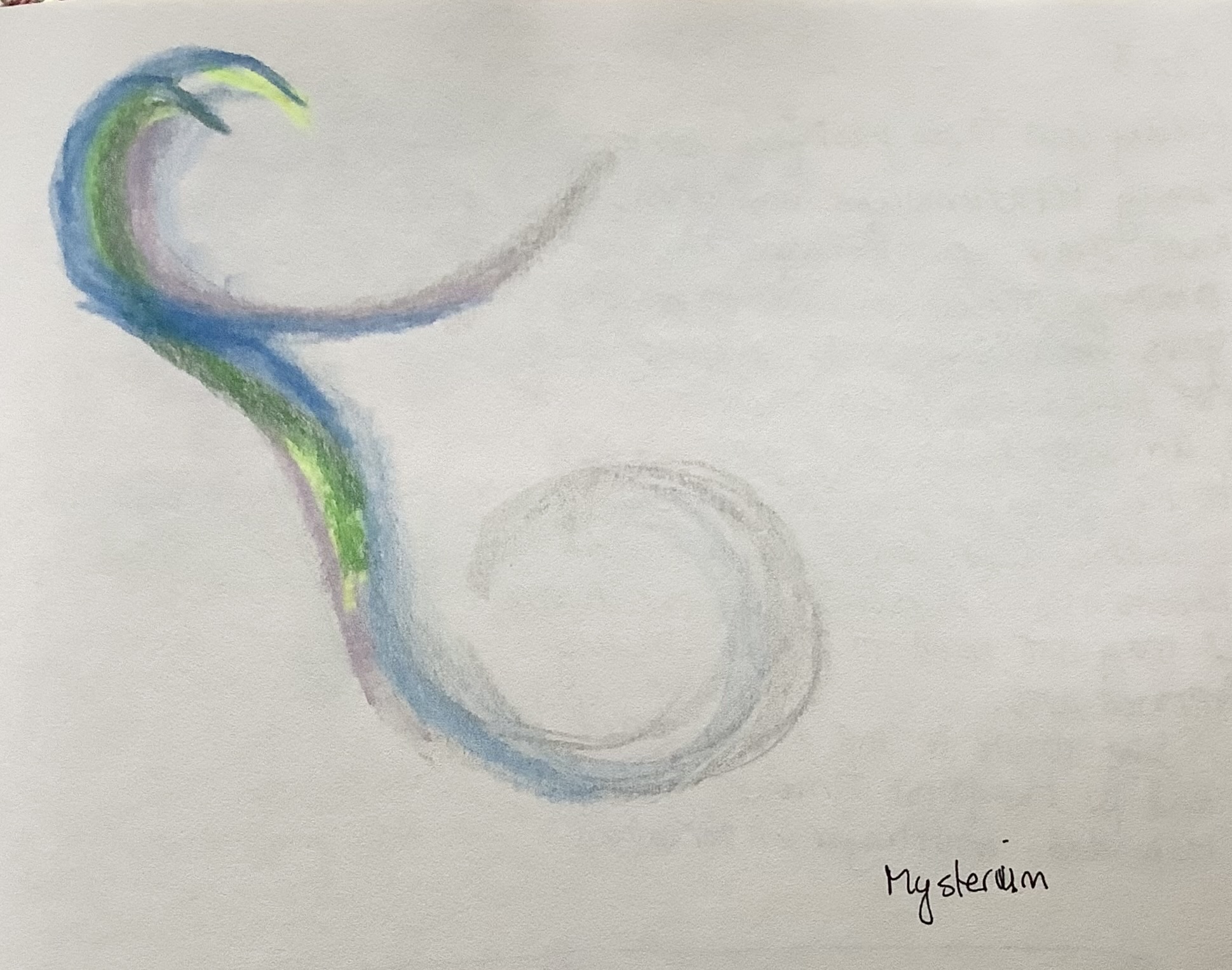
The string quaMysterium, drawing, colored pencilrtet continues to fall into shape, and the work is exciting. The previous agony was pressure during the most vulnerable stages of composing, of gathering the raw material together, finding tiny bits of flesh, atoms or protoplasm. The stuff of creation is a delicate process, full of uncertainty and patience. It is a time when I am open to outside fears and pressures.

The first section is almost completely mapped out. The rhythm tears along, bumping into sounds that are both unexpected and comfortable. I spin through reams of material, yet it is all connected somehow; tense, pressured, chased, inescapable, and swept away. I stitch together the fabric of the piece carefully, paying great attention to the transitions. The directions surprise the ear, and are, somehow, just right. The new shape of the piece pleases me, and has released the music inside. Unbelievable.


Excerpted from Let Your Heart Be Broken, Life and Music from a Classical Composer by Tina Davidson.  © Tina Davidson, 2022

Drawings by Tina Davidson:  Orb #1, charcoal and water color, Mysterium, colored pencil

Listen:


Filed Under: Uncategorized Tagged With: creative process, creativity, melodic work, original compositions, thoughts about musical composition, Tina Davidson, women composers, women in the arts, writing about music

Deep Listening

September 12, 2022 by Tina Davidson

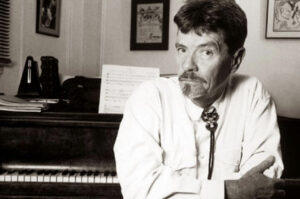
Pauline Oliveros and James Tenney

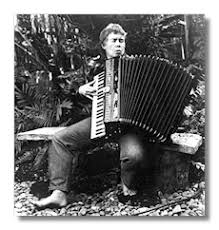
Pauline Oliveros playing the accordianA few days up at the Charles Ives Center for the Performing Arts gives me relief. I am in residence with musician, composer, and maverick Pauline Oliveros. “Hear, remember, and imagine,” she intones. You hear a sound, remember it, and then imagine it again. She uses words to form her music, bringing the performers into the process of creation. Her work begets community.
I am struck by music’s linear process, where duration is the great ingredient. Unlike visual art, music cannot be experienced all at once. Instead, it moves though time. As we listen, we construct the whole in our mind through memory. Like a transparent ghost, music moves our hearts with its lack of tangible substance.

∗∗∗∗

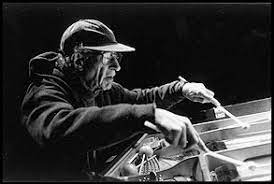
I heard a piece by composer Jim Tenney recently at a concert. Something interests me. HisComposer James Tenney piece is a voyage of technical manipulations involving tape delay and difference tones – those haunting resonances that appear when certain pitches rub against each other.


At first I am rapt. But, I cannot hold on, my mind disengages and falls into a dark quiet. After eight to ten minutes, the piece suddenly opens up, and I catch onto the piece again. How did I get here – where have I been? As if a white shirt, shown in meticulous technical detail, suddenly blossoms with blood, both a terrifying signal of death, and an affirmation of life.

The shape of his music reminds me of my own shape. While the content of our work is different, the linear shape and flow, moving from one point to (and through) another, is similar. He uses a one-theme-one-idea approach, where the starkness and persistence engages the listener. I am episodic, darting though material with single-minded purpose. His music is a straight line, mine moves in and over. He takes a fragment and expands it. I sew my fragments together, so one becomes another becomes one. His overall shape is like the stem of a flower, long and thin with a sudden bloom at the end. My shape is conical; the whole piece expands from a beginning point and opens up to an ecstasy. His epiphany is sharply beautiful in relief to his material. Mine is joyous and circular.


Excerpted from Let Your Heart Be Broken, Life and Music from a Classical Composer  by Tina Davidson.  © Tina Davidson, 2022

Listen: Wēpan for string quartet and piano, was written at the request of the Open End Ensemble. From the old English, wēpan means to weep, bewail, mourn over, or deplore.

I have written about Pauline Oliveros (1932-2016) before and I suspect I will write about her again. She is one of the great American composers, investigating new ways to focus attention on music including her concepts of “deep listening” and “sonic awareness.”

Jim Tenney (1935-2006), a pioneer of computer music, was interested in the possibilities offered by pure tuning. I met him in the mid-1980s and was drawn to him  as a fellow graduate from  Bennington College, and to his warmth, kindness and curiosity.


Filed Under: Uncategorized Tagged With: creative process, creativity, original compositions, process of composing, process of creating music, thoughts about musical composition, Tina Davidson, women composers, women in the arts

Learn to be Embarrassed

April 4, 2022 by Tina Davidson

By the time I arrived at Bennington College in 1972, I had never written a note of music. In fact, I had never played or heard any music by women composers. It never occurred to me that women could compose.

composer Vivian Fine
Vivian Fine

The music department boasted of four composers on their faculty – Louis Calabro, Vivian Fine, Lionel Nowak and Henry Brant. They believed that all performers should be composers, and all composers performers. Moreover, they eschewed the academic approach to composition that prescribed years of study of harmony and theory before you touched pencil to paper. They saw no need to waste precious class time with something you could teach yourself, and preferred to teach composition by allowing their students to write music and learn from the performance of it.

My freshman music class was taught by Lou Calabro, a loose-limbed man with slight stoop and a strong New York accent.  He was quick to give us our first assignment, to write a duet for two of our classmates. There was little instruction on how to compose. Staff paper was handed out.

I was distinctly grumpy, and muttered something about how all good music had already been written and all good composers were dead. But I wrote a piece for oboe and French horn. Twelve measures.

The piece was terrible, and the instrumentalists complained bitterly about the scattered notation and lack of dynamics. I vowed never to write for that combination again. But I was interested, and continued composing for my classmates.

By the end of my first semester, I was hooked. I knew what I wanted to do in life. It was as if, looking out into the forest, I could see many different paths, but only one was illuminated. More than that, I wanted to know who I was, and composing music was a way of finding out, without revealing too much. It was a place of investigation and almost complete anonymity.

composer Henry Brant
Henry Brant

The years at Bennington passed quickly. Tuesday afternoons the entire music department gathered and played all the music composed that week. Wednesday night was the weekly concert. I studied with witty and generous Vivian Fine, a former student of Ruth Crawford Seeger, and with iconoclast Henry Brant, famous for his acoustic spatial music. He was small, brown and never without cap or sunshade on his head. Because he was opinionated and sometimes difficult to study with, I asked him to be my advisor and surreptitiously brought him my scores to look at. His rules for orchestration were brilliant; I still review his notes carefully before I begin a new orchestra piece.

As composing became my voice, piano was my anchor. My teacher, Lionel Nowak, listened intently, eyes closed, as I played. “Get into the piano keys, like clay,” he would say, lifting up his head and waving one hand. “Dig deep into them – don’t be afraid, don’t back away from anything.”

composer Lionel Nowak
Lionel Nowak

“Courage!” He sat rumpled in the chair, his right index finger raised, “You must always dare to make a fool of yourself, and then you’ll be able to do things you never dreamed you could.”

He shrugged his shoulders, “Learn to be embarrassed.”

Bennington College was, in the end, seminal in my development as a musician and composer. The faculty did not teach me how to write music, instead they invited me in joyfully and with generosity. They fostered inclusion – everyone was worthy of this particular creative process, from bright-eyed beginners to sullen veterans. They believed learning was doing, again and again.

They taught me the difference between criticism and critical thinking. The former takes a stance of superiority, the latter is respectful and self-questioning – what works or doesn’t, and how can I do better next time. They were at the heart of artistic endeavour – bold, generous, humorous, and supportive. They taught me as a fellow composer, one of their tribe.


Excerpted from Let Your Heart Be Broken, Life and Music from a Classical Composer  © Tina Davidson, 2022.

Listen: Render, for string quartet was commissioned for the Cassatt String Quartet

https://soundcloud.com/tina-davidson-3/render-2016-for-string-quartet-excerpt-2?si=2ce244ae90d64934bb8f9c02dff17e96&utm_source=clipboard&utm_medium=text&utm_campaign=social_sharing

Filed Under: Uncategorized Tagged With: composing music, creative process, creativity, original compositions, process of composing, thoughts about musical composition, Tina Davidson, women in the arts, writing about music

Many are Called

May 1, 2021 by Tina Davidson

I moved to Philadelphia after graduating from Bennington College in 1976. I wanted to test the world as a composer. There was some question about how I should go about it. My brilliant and renegade Bennington teacher, Henry Brant, had no time for graduate school. “Just write music!” he practically shouted. “Write for your friends. Get it performed. Write more.” My parents, however, encourage me to think about graduate school.

My first job was at the University of Pennsylvania. Working full time, I was allowed to take two courses a semester for free. I wrangled a graduate composition class with a well-known composer. One fall afternoon, I brought in the first piece I had written after college for review, a large piece for full band that I labored over.

The eminent composer gravely considered my composition. We sat quietly, expectantly in chairs scattered around the graduate seminar room. Slowly, he turned the pages. The crisp sheets crackled. He looked without comment, and finally closed the score. Sitting back, he crossed his legs and lit a cigarette. Smoke floated and swirled around his face. “Many are called, but few are chosen,” he finally said.

We were silent; the criticism was implicit. My brain whirled frantically. “Get out of here!” it screamed. “Get away from teachers like this!”

 “Many are called, but few are chosen,” says Jesus at the end of the Parable of the Wedding Feast. What does he mean? The word ‘chosen’ implies a selection process. Jesus smiles; he is too full of love for exclusion. Well known psychiatrist and best-selling author Scott Peck deciphers it for me. “All of us are called by and to grace,” he writes, “but few of us choose to listen to the call.”

We are called, we do not listen. We have the capacity; we get sidetracked or confused. Scarcity is a false god. The world is large and full. The ability to create is a birthright. To be chosen, then, is merely to respond to the invitation. We only need believe and surround ourselves with those who say a resounding, infinite yes.

I did not complete the composition seminar that year, nor go on to graduate school. Deciding to take the advice of my teachers from Bennington College, I composed for friends and local ensembles and orchestras. Over the years, the circle widened. The National Symphony, Philadelphia Orchestra, the Kronos Quartet, The St. Paul Chamber Ensemble, and Hilary Hahn.

Showing up, I write the music.


Excerpted from Let Your Heart Be Broken, Life and Music from a Classical Composer  © Tina Davidson, 2022.

Listen: BLUE CURVE OF THE EARTH for solo violin (or violin and piano)
Commissioned by Hilary Hahn and recorded on Deutsche Grammophon in 2013 & 2018
“Grows into a lyrical world that literally seems capable of embracing the horizon. It is a shamelessly lovely piece.”  (Communities Digital News)

https://www.youtube.com/watch?v=2AaS8MkuQs8

Filed Under: Uncategorized Tagged With: Cassatt Quartet, Jesus, music journal, students composing, Tina Davidson, women in the arts, young composers

  • « Go to Previous Page
  • Page 1
  • Page 2

Footer

  • Listen on Spotify
  • Listen on SoundCloud
  • About
  • Press
  • Works
  • Blog
  • Contact
Join The Mailing List

© 2026 Tina Davidson · Photos by Nora Stultz