Not until the first snow of the year, did I know for certain that she was there. I had guessed as much, somewhere in the back ground, in the corner of my eye, in the undergrowth of my thoughts. But now, here were her footsteps, curling and meandering across my yard, like shafts of arching winter wheat.
I had heard her months before on the edge of sleep. A cry, a half-shriek or moan, almost like an animal mortally wounded. Stumbling out of bed, I stood by the open window and waited. The sound recalled my childhood. Late one afternoon, our dog appeared with a small brown rabbit in his large jaws. Terrified, the rabbit’s mouth was shaped like an oval as it screamed continuously – a bowels of the earth sound.
This, was no rabbit, however. Instead a vixen in heat, calling out an ancient enticement for a mate.
I started to set out scraps of meat for her, a fresh bone or two, a nightly snack – just something to keep her going in the winter. I know, I know. This is against all current wisdom: do not interfere with nature, or make wild animals dependent on humans. But, in truth, either by choice or necessity, foxes live in my neighborhood; we are part of the same ecosystem.
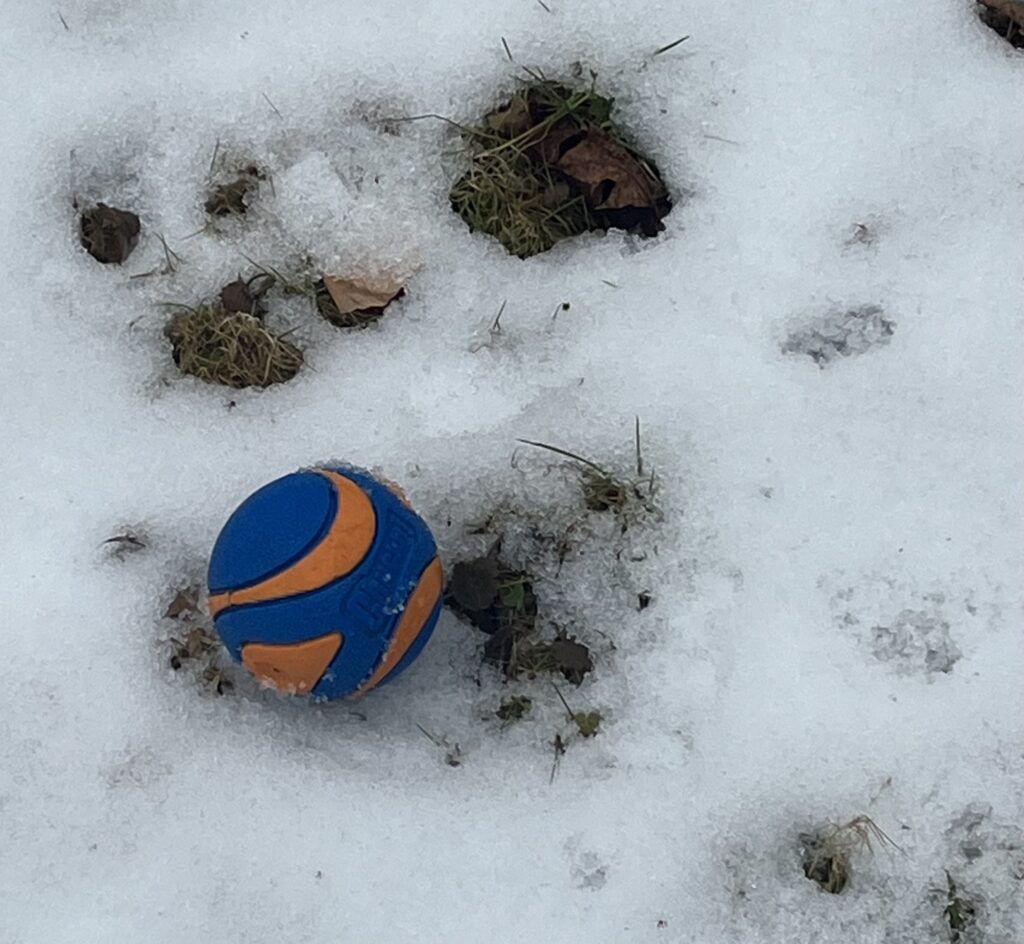
Small traces of her began to increase. The plastic dishes I laid out were scattered around the yard, often decorated with round puncture marks. Then, a carefully composed dropping of scat on the walkway, later, on my doorstep. A blue ball was left under the apple tree.
One evening I looked out the window and there she was. Slender black legs, thick red orange fur, and a laughing face. She approached the food as if it were a foreign object, jumping back in caution. Circling, she lay on her stomach and slid forward to eat, only to dance away again. Finally she finished it, and began to move gracefully off, stopping to look around every few steps.

Her movements were both of curiosity and caution. It made me smile. She had none of the cruel intensity I had as a young composer, where insistence was the only path forward. I was singular, driven, and compulsive. A straight line, a harsh beam of light, always thinking about what to create. Preoccupied and rarely in the moment, I was angular and often strident.
Now, in my seventies, I am more tamed. c is no longer one-directional, scraping and scouring rocks. It oozes, bubbling towards my writing and composing, my garden, and my friends. I have more elasticity, more contours.
I have, I think, learned wisdom, by being humbled through experience. I no longer move at a fast pace or travel long distances. Instead, the reach is deep, and as connections come to the surface, words are there to articulate them. Before I was a runner aimed for the horizon. Now I have a spade; I dig.
Age has not taken away my ambition – the belief I still have something important to add. I grapple with doubts or vulnerabilities, but I have learned how to be more fluid and gentle, like the fox’s looping footsteps.
I soften at the sight of her. For all her grace, she is no fool. While she is not possessed or driven, she knows the boundaries and carefulness of living.
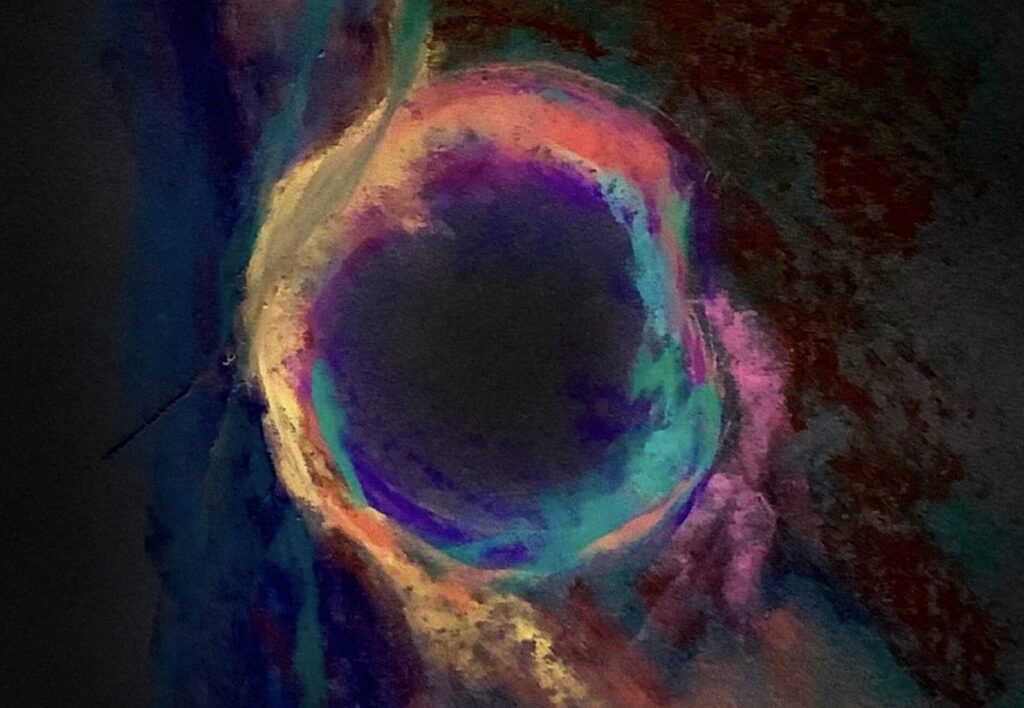
I search to name her. I am thinking of Interstellar, or Inter Stellar. Borrowed from Latin, stēllāris, it is of or pertaining to stars, like the ones she roams under. And, both of us are are “inter” or between stages. She, a wild creature living in a tamed neighborhood, and I, a human living with the passage of time.
Like her, I pause to sniff before moving a few more steps forward. I pick up my head and gauge the shifting patterns.
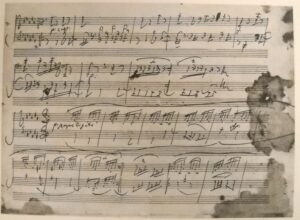 of his playing, however, distracts me. What is it about the escalating speeds in performances of musical works?
 In other words, once a barrier is broken, it becomes a standard. A gifted athlete – or prodigy performer – creates a new marker of normal.
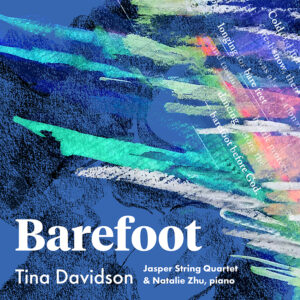
 Last year, I was in rehearsals with the Jasper String Quartet and Natalie Zhu. We were preparing for the the recording of my latest album, Barefoot. The quartet were playing my difficult work beautifully; seamlessly moving through the tricky meter changes and the rambunctious middle section.
 There are plenty of examples of badly behaved composers. Gesualdo committed a gruesome murder and mutilation of both his wife and her lover, Beethoven was famously temperamental and more than a bit abusive to his nephew, and Wagner was a fervent anti-Semite. Scriabin was a pathological narcissist who imagined himself a god and Mussorgsky was a raging, out-of-control alcoholic who idealized his addiction. Closer to home, I know many good composers I would rather not spend any time with.
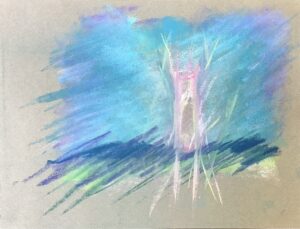 “Without music, I am plain and unremarkable. I shop, eat, dally about, think foolish thoughts, peer into the mirror. I hate, I love, I sleep, I anguish—nothing special. But when focused on writing music, I am a channel, a beam of light – I am a passageway for what must come out. My entire person comes together in a pulse, condensed and absorbed. The work follows me everywhere. I hear it in the bathroom, while I am cooking, as I fall asleep. There is always this murmur, this whisper.” (page 47)
 The relationship between my life, who I am and how I behave, and my work is inseparable. There is no slacking off in either regard. I am as flawed as the next person, but it is how I am accountable to and work on those flaws that matters.
 I miss my little dog Max at the oddest times. Not when I look at his collar or his leash laid out next to my bed stand, but in the middle of the night when I absentmindedly reach up to pat the space where he used to sleep. Isabella carefully sleeps down at the bottom of the bed, out of the way of any movement.
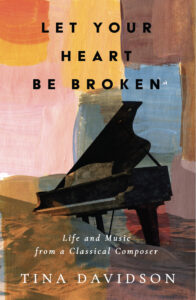 I am reading my memoir, Let Your Heart Be Broken, aloud for the audiobook. This is not an easy thing to do. I have a new respect for the muscles of the lips, mouth and cheek, and where I put my tongue to articulate a word. I am constantly dropping plurals, fumbling over words, or seeing the end of the sentence at the same time I see the beginning, and reordering the words. My engineer often raises his head from my book as he follows along with a look, and even will repeat a fugitive word for me.
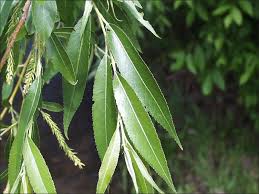 My neighbor, on the other side of the creek, cut down a slender adolescent oak I had been nurturing. In a confusion of where the property line was between our houses, the oak found itself outside of my jurisdiction. So he gleefully chopped it down, and dug up all the roots for good effect.
 I sigh and drum my pencil on the blank score paper. All morning I have been procrastinating, unable to move forward in composing my next work. I am caught in the bardo of creation – between not knowing and, at the same time, sensing the direction of the piece.
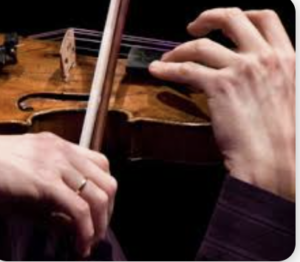 My ear is always bending towards the sound strings produce when I compose. The instrument itself is an ingenuity of construction – as one plays, the open strings resound, building up a deepening of sound – like a piano’s sustaining pedal, but discrete and selective. The resonating strings respond like ghosts to a call, building up overtones and harmonics, even different tones.
 sound to a bare shadow of itself by playing with the wood of the bow) gets closer to what I experience in a single note or tone – an outer shell-like-flesh with a soft inner core.