By the time I arrived at Bennington College in 1972, I had never written a note of music. In fact, I had never played or heard any music by women composers. It never occurred to me that women could compose.
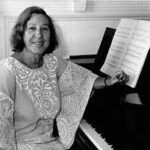
The music department boasted of four composers on their faculty – Louis Calabro, Vivian Fine, Lionel Nowak and Henry Brant. They believed that all performers should be composers, and all composers performers. Moreover, they eschewed the academic approach to composition that prescribed years of study of harmony and theory before you touched pencil to paper. They saw no need to waste precious class time with something you could teach yourself, and preferred to teach composition by allowing their students to write music and learn from the performance of it.
My freshman music class was taught by Lou Calabro, a loose-limbed man with slight stoop and a strong New York accent. He was quick to give us our first assignment, to write a duet for two of our classmates. There was little instruction on how to compose. Staff paper was handed out.
I was distinctly grumpy, and muttered something about how all good music had already been written and all good composers were dead. But I wrote a piece for oboe and French horn. Twelve measures.
The piece was terrible, and the instrumentalists complained bitterly about the scattered notation and lack of dynamics. I vowed never to write for that combination again. But I was interested, and continued composing for my classmates.
By the end of my first semester, I was hooked. I knew what I wanted to do in life. It was as if, looking out into the forest, I could see many different paths, but only one was illuminated. More than that, I wanted to know who I was, and composing music was a way of finding out, without revealing too much. It was a place of investigation and almost complete anonymity.
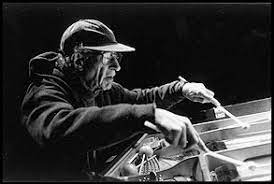
The years at Bennington passed quickly. Tuesday afternoons the entire music department gathered and played all the music composed that week. Wednesday night was the weekly concert. I studied with witty and generous Vivian Fine, a former student of Ruth Crawford Seeger, and with iconoclast Henry Brant, famous for his acoustic spatial music. He was small, brown and never without cap or sunshade on his head. Because he was opinionated and sometimes difficult to study with, I asked him to be my advisor and surreptitiously brought him my scores to look at. His rules for orchestration were brilliant; I still review his notes carefully before I begin a new orchestra piece.
As composing became my voice, piano was my anchor. My teacher, Lionel Nowak, listened intently, eyes closed, as I played. “Get into the piano keys, like clay,” he would say, lifting up his head and waving one hand. “Dig deep into them – don’t be afraid, don’t back away from anything.”
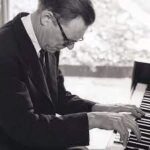
“Courage!” He sat rumpled in the chair, his right index finger raised, “You must always dare to make a fool of yourself, and then you’ll be able to do things you never dreamed you could.”
He shrugged his shoulders, “Learn to be embarrassed.”
Bennington College was, in the end, seminal in my development as a musician and composer. The faculty did not teach me how to write music, instead they invited me in joyfully and with generosity. They fostered inclusion – everyone was worthy of this particular creative process, from bright-eyed beginners to sullen veterans. They believed learning was doing, again and again.
They taught me the difference between criticism and critical thinking. The former takes a stance of superiority, the latter is respectful and self-questioning – what works or doesn’t, and how can I do better next time. They were at the heart of artistic endeavour – bold, generous, humorous, and supportive. They taught me as a fellow composer, one of their tribe.
Excerpted from Let Your Heart Be Broken, Life and Music from a Classical Composer © Tina Davidson, 2022.
 Listen: Render, for string quartet was commissioned for the Cassatt String Quartet