• Skip to main content
  • Skip to footer

Tina Davidson

Composer

  • About
    • Biography
    • Community Engagement
  • Press
    • Press
    • Interviews & Podcasts
  • Works
    • Works
    • Listen
    • Recordings
    • Publications
  • Blog
  • Contact

process of composing

Dancing with Dogs

August 9, 2025 by Nerissa

I open up the side porch, and sweep up all the winter dirt. The dogs and I sit in the sun, listening. Isabela, hopeful that she can magically transport herself next to the squirrel on the lawn, thrills an undertone growl and pants.

The earth is beginning to wake up. Daffodils bloom, and birds sing and sing. I am half hibernating between projects. A new piece soon?
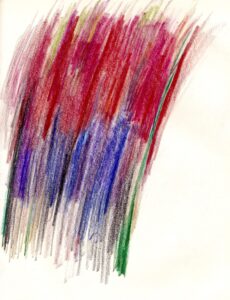
Trembling. This part of composing is always difficult; the hearing it into existence. Half of me is eager, the other half resistant – wanting to scale back, to sink back into bed, into books, into a life of teaching, and nothing more. My energy flags, my spirits gray out.


The book, In Other Words by Jhumpa Lahrir, is beautiful and rich. Her writing about the separation of self at an early age and the need to find home resonates deeply with me.

For her, it is in language. Caught between Bengali and English, she turns, as an adult, to Italian and begins to learn it without the comforts of a native tongue.

Delving deep into the language – now speaking, reading and writing in it, she becomes unchained from the desire for perfection. Her Italian will always be imperfect, and thus more free. “Imperfection inspires invention, imagination, creativity. It stimulates. The more I feel imperfect, the more I feel alive,” she says.
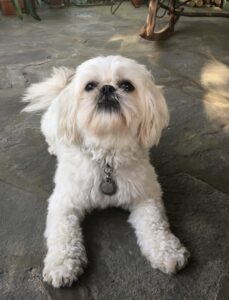
 

I danced with the dogs last night and ate sweet ripe oranges, fennel salad with tuna and avocado.

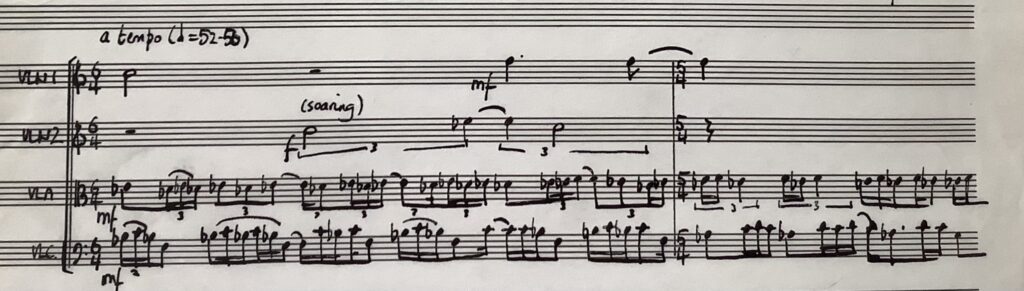
I worked on my new string trio, creating a fabric with sound – oscillations, repeated notes sliding upwards; a throbbing.


From concert to concert, I go, half drunk with sound. Poulenc’s choral work one night is followed by the Jasper Quartet’s performance of a work by Aaron Kernis. Then, the play “Still” at Julliard, and tomorrow, Piazzolla’s Cuatro Estaciones Porteñas.

I have become a glutton for moments that touch and move me forward in my understanding, thinking, and feeling. I am always looking for the meeting between deep investigation and spiritual presence.

Filed Under: Uncategorized Tagged With: dogs, process of composing, thoughts about musical composition, Tina Davidson

Inter Stellar

March 3, 2025 by Tina Davidson

Not until the first snow of the year, did I know for certain that she was there. I had guessed as much, somewhere in the back ground, in the corner of my eye, in the undergrowth of my thoughts. But now, here were her footsteps, curling and meandering across my yard, like shafts of arching winter wheat.

I had heard her months before on the edge of sleep. A cry, a half-shriek or moan, almost like an animal mortally wounded. Stumbling out of bed, I stood by the open window and waited. The sound recalled my childhood. Late one afternoon, our dog appeared with a small brown rabbit in his large jaws. Terrified, the rabbit’s mouth was shaped like an oval as it screamed continuously – a bowels of the earth sound.

This, was no rabbit, however. Instead a vixen in heat, calling out an ancient enticement for a mate.

I started to set out scraps of meat for her, a fresh bone or two, a nightly snack – just something to keep her going in the winter. I know, I know. This is against all current wisdom: do not interfere with nature, or make wild animals dependent on humans. But, in truth, either by choice or necessity, foxes live in my neighborhood; we are part of the same ecosystem.

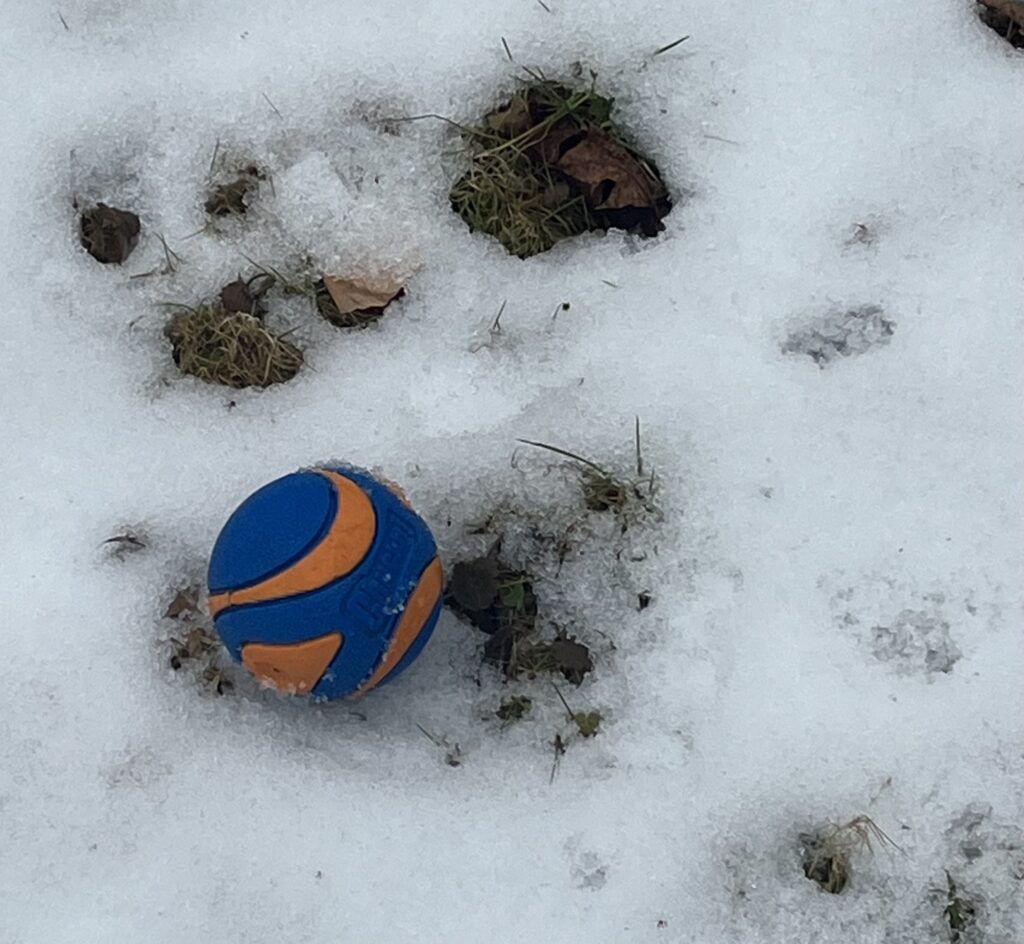
Small traces of her began to increase. The plastic dishes I laid out were scattered around the yard, often decorated with round puncture marks. Then, a carefully composed dropping of scat on the walkway, later, on my doorstep. A blue ball was left under the apple tree.

One evening I looked out the window and there she was. Slender black legs, thick red orange fur, and a laughing face. She approached the food as if it were a foreign object, jumping back in caution. Circling, she lay on her stomach and slid forward to eat, only to dance away again. Finally she finished it, and began to move gracefully off, stopping to look around every few steps.

Her movements were both of curiosity and caution. It made me smile. She had none of the cruel intensity I had as a young composer, where insistence was the only path forward. I was singular, driven, and compulsive. A straight line, a harsh beam of light, always thinking about what to create. Preoccupied and rarely in the moment, I was angular and often strident.

Now, in my seventies, I am more tamed. c is no longer one-directional, scraping and scouring rocks. It oozes, bubbling towards my writing and composing, my garden, and my friends. I have more elasticity, more contours.

I have, I think, learned wisdom, by being humbled through experience. I no longer move at a fast pace or travel long distances. Instead, the reach is deep, and as connections come to the surface, words are there to articulate them. Before I was a runner aimed for the horizon. Now I have a spade; I dig.

Age has not taken away my ambition – the belief I still have something important to add. I grapple with doubts or vulnerabilities, but I have learned how to be more fluid and gentle, like the fox’s looping footsteps.

I soften at the sight of her. For all her grace, she is no fool. While she is not possessed or driven, she knows the boundaries and carefulness of living.

I search to name her. I am thinking of Interstellar, or Inter Stellar. Borrowed from Latin, stēllāris, it is of or pertaining to stars, like the ones she roams under. And, both of us are are “inter” or between stages. She, a wild creature living in a tamed neighborhood, and I, a human living with the passage of time. 

Like her, I pause to sniff before moving a few more steps forward. I pick up my head and gauge the shifting patterns.

Filed Under: Contemporary Music, Uncategorized Tagged With: aging, composing music, creative process, foxes, interstellar, passage of time, process of composing, snow, Tina Davidson, wild creature, woman composer

The Death of Finale

February 4, 2025 by Tina Davidson

Recently, the music notation software, Finale, long considered the industry standard, announced that it would end production. Although the software would be permanently available to download, the company would longer provide upgrades, particularly when the computer operating system changed.  In other words, soon Finale would be obsolete, and most probably the music created using it would no longer be accessible.

I, like many other composers, was panicked. I had used the software for over thirty years, and almost all of my music catalogue was in Finale. I had made PDF files of all my scores for ease of printing, but any re-editing or correcting had to be done on the original file.

Finale assured composers that all was not lost; music could be migrated to another notation software system. However (why is there always a however?) this entailed a lot of re-editing. Most of the dynamics had to be reentered, glissandos were all over the place, and any unconventional notation was illegible. I was looking at hours and hours of work to upgrade each piece. The prospect was daunting at best, terrifying at worst.

Of course, I was glad I wasn’t dead. That would have been a real problem.

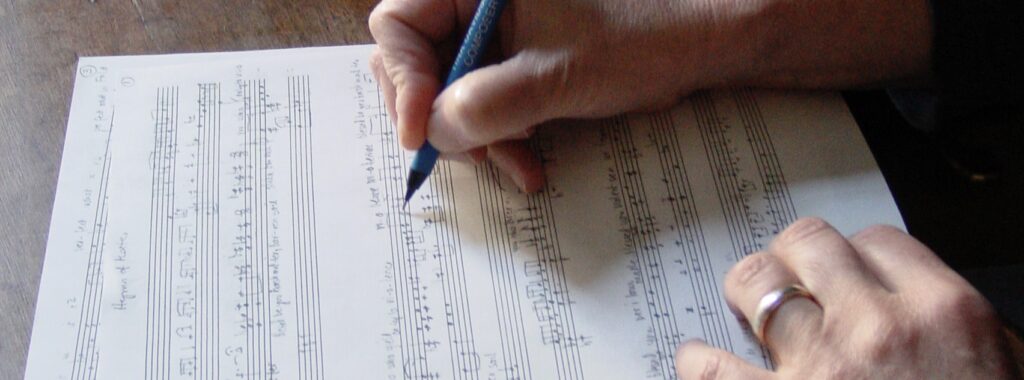
I came to age as a composer in the mid 1970’s. To create a score, I used vellum or onion skin, a durable, semi-transparent material pre-printed with a staff. Using various well chosen pens and India ink, I would copy out my music. The manuscript was then reproduced through an ozalid process. 

This mode of copying was time consuming. The vellum had to be dusted with talcum powder so the ink would stick. Pen nibs needed meticulously cleaning, and mistakes were scraped off or even cut out. Once the score was created, each part needed to be copied out separately on vellum. Imagine an orchestra piece with 24-28 parts; it was a proof-reading nightmare.

When photocopiers became available, I switched to handwriting the score with pen and paper.  I corrected mistakes with white-out fluid, and cut a photocopied score up and glued the parts onto separate sheets of paper. The only drawback was that the parts would constantly come unglued, often falling into a tangled mess.

I began using a computer and the Finale software in 1991 with a great sigh of relief. Quickly I learned how to key in the notes, adjusting the formatting to my own personal satisfaction. My music was now more regulated and easier to read. Parts were extracted from the score and I sent them to performers by mail, or electronically as a PDF.  This was a best case scenario.

The advent of music software, coupled with direct access to the world wide web has been a great equalizer for artists. Before the internet, publishers (museums or libraries) were gate keepers. They selected artists they wanted to represent and made them ‘important.’  Now, composers became their own publishers, creating websites to publicize and sell their music directly to performers. More than that, the digital age offered artists – offered me – the taste of the promise that my work would endure, some place in the big somewhere. That my work would survive and have a life beyond mine. 

Artists are always concerned with the preservation of the works they have created over a life time. First, will the material used – the paper or ink – stand the test of time?  Secondly, how will the works continue to get out to the public? Are there publishers who will make the music available to performing ensembles after the death of the artist? Are there libraries, museums, or archives that will store and protect the work?

We live in a time of diminishing resources to safeguard the legacy of music created by American composers. We have no national repository in the way that other countries have. Canada, for example, has a library of all its composers’ works available to view, study or perform. In other words they honor and treasure their country’s artists; the US does not. And publishers have neither the financial resources nor the interest in representing composers that are not currently successful. 

The internet and the availability of music in a viable software system is of great importance; it will house, remember, preserve, and make available works of all composers – so that this generation of composers, who speak of our time, will be remembered.

The Finale-end-of-the-road reminds me of the false promise in terms of permanence. I look at my music paper with renewed fondness.

Filed Under: Uncategorized Tagged With: composing music, creative process, Finale, process of composing, Tina Davidson

Barefoot in Winter

September 3, 2024 by Tina Davidson

I am sitting in my music studio, a few days into a month residency at MacDowell in New Hampshire. Outside is icy cold; the snow leans up against the studio and icicles hang off the small moss-covered shed roof.

I sigh and drum my pencil on the blank score paper. All morning I have been procrastinating, unable to move forward in composing my next work. I am caught in the bardo of creation – between not knowing and, at the same time, sensing the direction of the piece.
I wait and close my eyes, thinking about summer and soft warm dirt between my bare toes, the color a milk chocolate. In my mind’s eye, I turn and spin, remembering that Moses, as he approached the burning bush, took off his sandals to stand on holy ground.

Of course! Barefoot. The sound of the new work wells in my ears; I am flooded.

I grew up as a pianist in a household of strings. My mother was an avid amateur violinist and my sisters played violin and viola. I envied their ability to play with others, while I was continually on my own. In college, I took up cello in addition to studying composition and piano. I studied with Michael Finkle, who was mustached, quirky, and full of joy. We gathered weekly to play cello quartets and octets late into the evening. Then, turning off the lights, we improvised in the dark.

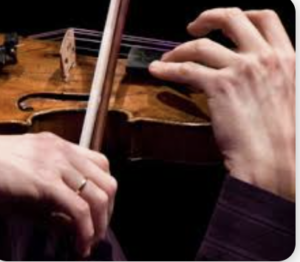
My ear is always bending towards the sound strings produce when I compose. The instrument itself is an ingenuity of construction – as one plays, the open strings resound, building up a deepening of sound – like a piano’s sustaining pedal, but discrete and selective. The resonating strings respond like ghosts to a call, building up overtones and harmonics, even different tones.
I love the immediacy a string player has between themselves and the sound they produce. Pressing the flesh of their finger into string, they bow to bring the pitch to life. With this comes the unique ability to bend a note easily through a glissando. This is aslide between notes, not a fast get-away, but a way of directing energy from one note to another. Sometimes I want to pierce through a note cleanly, like an arrow through the heart. Other times, I move between two notes, creating a slow-motion tension, where the departing note comes so close to the next note that union is magnetic and unavoidable.

The string instrument is a master of getting to the kernel of sound by varying the way a sound is made. Pizzicato and tremolo are most common, but, for me, ponticello (playing close to the bridge to make a scratching, buzzing sound) and col legno (reducing the sound to a bare shadow of itself by playing with the wood of the bow) gets closer to what I experience in a single note or tone – an outer shell-like-flesh with a soft inner core.
I am always composing towards the center of sound, to get as close as I can. And always, in a stream of movement, a consciousness liquid enough to become something else at any moment. Lean and snake-like, my music is continually circular and linear, transforming in a seamless continuity.

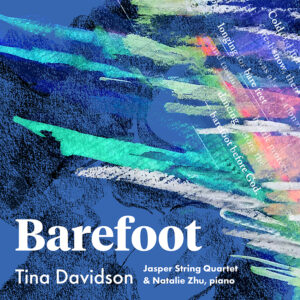
String writing in Barefoot

LISTEN: https://lnkfi.re/barefoot

Tremble for violin, cello and piano, has no end of movement – we shiver in delight or quake in fear. We shake in anger or pulse in love. We tremble in the act of knowing and not knowing.

Barefoot for violin, cello, viola and piano is cold and full of fresh snow, and always a longing for bare feet on green forest paths and creek beds. The dashing out and tasting life with little protection, the dancing before the burning bush – barefoot before God.

Wēpan for string quartet and piano is full of slippage from one note to another – glissandos between note to note; weeping, endless weeping.

Hush for violin and piano is quiet and reflective – a sweet calming of our child, ourselves and those around us – a stillness so that life can be experienced, cascading around us.

Leap, for violin, cello, viola and piano, was written during the pandemic when we found ourselves having leapt into a world unrecognizable. Restless and often sudden, the strings echo each other, searching and slightly out of tune.

Tina Davidson’s new album Barefoot, featuring the Jasper Quartet and pianist Natalie Zhu, is released on New Focus Recordings.  


Filed Under: Contemporary Music, Uncategorized Tagged With: #composing, #stringquartet, #works for strings, Authentic self-expression, composing music, creative process, process of composing, Tina Davidson, woman composer, women in the arts

Why I Compose Music as a Woman

May 1, 2024 by Tina Davidson

In these days of growing numbers of nonbinary, gender-nonconforming and transgender people, I have been reflecting on how and why I compose music as a woman. I wince a little as I write this. It does not seem current, or perhaps currently relevant.

I came to composing over forty-five years ago when feminism was in it’s second wave, where the focus was on the inequality and discrimination of women. It was a time when women were speaking out about the marginalization of their choices and expertise, it was about being seen and counted.

My mother was the first feminist in the family. She read Gloria Steinem, Kate Millett, Germaine Greer and Betty Friedan. She taught women’s studies and went to on countless marches. True, she often spat and lectured. A professor at the State College in Oneonta, mother of five, she knew the limits of her salary and position. She had valid grievances and was angry.

I was a second generation feminist. I read Alex Katie Schulman, Erica Jong, Adrienne Rich and Alice Walker. Early on, I didn’t wear a bra or shave my legs. I worked to pass the equal rights amendment, and went on marches, taking my daughter in a stroller. Feminism, for me, was personal and deeply related to finding my voice in a male dominated music world of the late 1970s. I needed to grow myself, and I wasn’t sure how.

I am reminded of the summer I was eleven and I lived with my aunt and uncle who were scientists in Cambridge, England. One day they brought home small plates from their laboratory coated with agar, a clear medium that fuels microbes and bacteria as they grow. My job was to see what was really on our household surfaces. Carefully I took samples from the kitchen and bathroom and spread them on the agar. Uncle John pressed his thumb on one of the plates. We waited to see what emerged. Colors bloomed several days later, a brilliant white and a poisonous looking orange – a world invisible – existing only when it was allowed to grow by itself.
My agar medium, as I think back on it now, was feminism, or seeing myself as female. And it was Beethoven, oddly enough, who gave me permission to culture and cultivate myself.

Classical music, whose language and history I grew up in, carried forward the idea that music is ‘universal’ in its expression. In 1818, Schopenhauer wrote that music “is such a great and exceedingly noble art …  a perfectly universal language, the distinctness of which surpasses even that of the perceptible world itself.”  Soon came the claim that classical music works were masterpieces – above and beyond our daily lives.

This superlative description of music confounded me. Instinctively, I felt that the artistic endeavor came out of an authentic expression of myself, or as close as I could get to an inner truth. Take Beethoven, for instance. He wrote richly genuine music, an expression of who he was: a white, educated, Christian, and upper middle class. And male.

I shivered. A male aesthetic, not universal at all. And I was female.

With this realization musical world opened up and works came tumbling out. While composing, I held words in my mind that related to myself and the world around me – not to create a ‘tone-poem’ or music describing a story, but as a way of exploring and understanding myself. Cassandra Sings, commissioned by the Kronos String Quartet, was both the anguish of the Greek prophetess who was never listened to or believed, and my hope for better times in the future. Women Dreaming, for mixed ensemble and piano, was my continued dreaming of possibilities. River of Love, River of Light, a seven movement choral piece, was my understanding of the female face of God.

Feminism was, in an odd way, my lucky break. In pushing forward to illuminate the wealth of the individual, giving credibility to the female gender, I found my agar plate. It was a rich medium to explore myself, to grow my work from the hidden secrets of my inner and outer surface. To press my thumb down, and see what was revealed by my print.

After a decade of composing, I softened. I became more digested and reformulated; more fully mixed. My interest began to shift from an inner to an outer relationship to the world, and my gaze looked upwards. What was the connection to the larger whole, to the sky, earth, to the unnamable? From these eyes that belong to a woman?

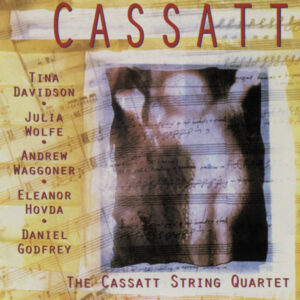
Filed Under: Contemporary Music Tagged With: Cassatt Quartet, Classical contemporary music, composing music, creative process, feminism, music by women, process of composing, thoughts about musical composition, woman composer

  • Page 1
  • Page 2
  • Page 3
  • Go to Next Page »

Footer

  • Listen on Spotify
  • Listen on SoundCloud
  • About
  • Press
  • Works
  • Blog
  • Contact
Join The Mailing List

© 2026 Tina Davidson · Photos by Nora Stultz