• Skip to main content
  • Skip to footer

Tina Davidson

Composer

  • About
    • Biography
    • Community Engagement
  • Press
    • Press
    • Interviews & Podcasts
  • Works
    • Works
    • Listen
    • Recordings
    • Publications
  • Blog
  • Contact

creating music

You are What You Eat

December 2, 2024 by Tina Davidson

As an artist, does one need to be a good person to create good work? I’m a little embarrassed; it seems like a silly question, but it has nagged at me over these many years.

I have always maintained that ‘you are what you eat,’ and I feed myself well. To support the music I create, I spend a lot of time reading, journaling, and drawing. I get outside and garden, take long walks, spend quiet evenings meditating or thinking. I go to art museums, music and theater performances – filling my head and heart with enriched fertile soil to grow the music I compose.

But do my actions – how I treat others – find their way into my music as well?  If I am careless or cruel to my partner, children or friends, if I am selfish, self-centered, even narcissistic, will these character traits translate into my music? How does who I am effect my music, possess it, even corrupt it? Crassly put, can bad people write good music?
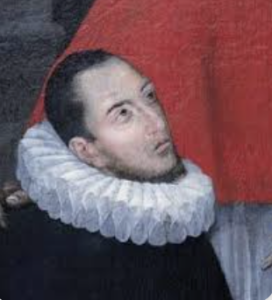
There are plenty of examples of badly behaved composers. Gesualdo committed a gruesome murder and mutilation of both his wife and her lover, Beethoven was famously temperamental and more than a bit abusive to his nephew, and Wagner was a fervent anti-Semite. Scriabin was a pathological narcissist who imagined himself a god and Mussorgsky was a raging, out-of-control alcoholic who idealized his addiction. Closer to home, I know many good composers I would rather not spend any time with.

How can I understand this from my own life perspective? Perhaps it is in the creative process itself that I might find common ground.

When I compose, it is as if I have two lives – one that is music and the other one that is every day. Call it a split personality or a double self, I project myself into this realm, into this voice – my second self. As I wrote in my memoir, Let Your Heart Be Broken,
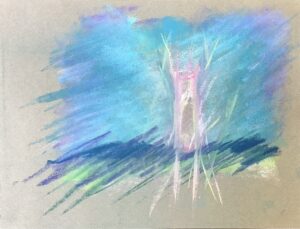
“Without music, I am plain and unremarkable. I shop, eat, dally about, think foolish thoughts, peer into the mirror. I hate, I love, I sleep, I anguish—nothing special. But when focused on writing music, I am a channel, a beam of light – I am a passageway for what must come out. My entire person comes together in a pulse, condensed and absorbed. The work follows me everywhere. I hear it in the bathroom, while I am cooking, as I fall asleep. There is always this murmur, this whisper.” (page 47)

In my composing life lies untethered ground, unhampered by anger, pettiness, and dis–ease. This neither-here-nor-there state becomes a clean slate and a dreamland where all is possible. I can articulate deep feelings of connection and love without encumbrance of my more human emotions. I can turn my night sweats, jealousy and rage into energy and rhythm, dissipating their destructive force. I am, as I compose, a better person, an imagined best.

In this way, I understand how badly behaved composers write good music. In this composing dream-world, they can exist emotionally open, kind and connected. Whereas in daily life, they can be harsh, cruel, mentally unstable and even murderous.

But, honestly, this doesn’t work for me.
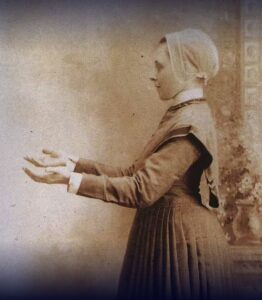
The relationship between my life, who I am and how I behave, and my work is inseparable. There is no slacking off in either regard. I am as flawed as the next person, but it is how I am accountable to and work on those flaws that matters.

In the end, I ascribed to the Shaker’s motto, hands to work, hearts to God, where “every part of life is a spiritual manifestation of God – the God within – whether they make furniture or say their prayers” (Let Your Heart Be Broken).

The glue in my life is that I am always working to be the best I can be. My imagined best that I project into my music is my true north.

© Bottle, Tina Davidson, pastel

Read Let Your Heart Be Broken, Life and Music from a Classical Composer

https://www.amazon.com/Let-Your-Heart-Broken-Classical/dp/1633376974

Filed Under: Contemporary Music Tagged With: Authentic self-expression, creating music, creative process, Gesualdo, Good Person, Shakers, Tina Davidson, woman composer, women in the arts, writing about music

Redemption Song

May 1, 2023 by Tina Davidson

Each Monday I work with the residents who live in the YWCA shelter facility for women and their families. I have just started my Meet The Composer residency, and will work with the women, helping them to write operas of their own lives.

I am teamed with writer and director Zadia Ife, who runs the IYABO program, a parenting skills class. She is lovely and thin, and suffers from a chronic illness that often leaves her exhausted, sometimes for days. I know, first hand, the carefulness with which she leads her life. We go out to lunch; she has forgotten her coat. She stops and silently calculates how much energy it would cost to run back. She shivers all through lunch.

We meet with the women in the kitchen of the shelter in evenings. Sitting in a circle in the large blue tiled kitchen, I am quiet during the first couple weeks, and feel my privilege with embarrassment. I am a total novice. Under Zadia’s guidance, I begin to learn. I use her credibility to gain admittance into this world; she is my access card.

The women in the residence are kind to me, and slowly over the weeks, we get to know each other. They reveal their stories of poverty, child abuse, beatings and addictions. Many of them have lost their children to foster care. All are homeless, but tough and resilient.

I lead a meditation to help them reconnect with their stories. We close our eyes and go back to the house of our childhood. “Listen,” I tell them,  “What do the walls remember?” Memories emerge, triggered by a door, a closet, or a heating grate. They sing their stories; I write them down.

We begin to create a performance piece they call Redemption Song. Zadia will write the script and they will compose the songs. They will perform it next year at the Jesus Be Ready Church.

Taking down the pots and pans of the kitchen, we make a drum circle as part of the piece. Laughing, singing and sometimes crying, they create a work containing their stories, their songs – their sorrows, joys, and their hopes for a different life.

Tina Davidson’s Meet The Composer residency (1991-94) was their first national residency that worked directly with a social service agency. With host organizations, OperaDelaware, Newark Symphony and the YWCA, she wrote a major work for each  organization, and worked weekly with women at the YWCA shelter, helping them compose operas of their lives.

Listen to Tina Davidson’s opera, Billy and Zelda
https://soundcloud.com/tina-davidson-3/billy-and-zelda-5-songs-compilation?si=72005be03990401d935f9e1166fd8f73&utm_source=clipboard&utm_medium=text&utm_campaign=social_sharing

Filed Under: Uncategorized Tagged With: composing music, creating music, creative process, music by women, opera, process of composing, women in the arts, working with communities

How Will I Know When to Stop?

May 2, 2022 by Tina Davidson

Timothy stands close to me. When I move, he moves. He waits for me to play his piece with him and follows me like a shadow around the room.
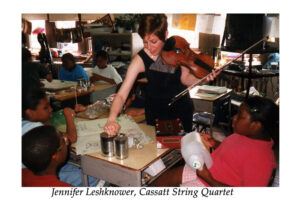
I help Shante with her instrument, calm Ferron down so he can concentrate, and get sidelined by Brandi and Terrell. They work on a piece for two desks and their hands. Experimenting with fingers, palms, and fists, they make sounds on the wooden tops. I step back and almost fall over Timothy; he is patient.

Jake and Michael struggle with their invented notation. Jake’s faces contorts, he cannot figure out how to write his rhythm down. We put words to the melody, and suddenly he claps it with ease.

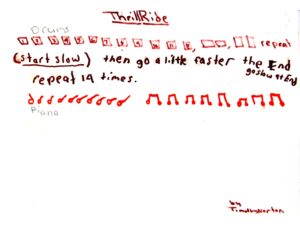
Timothy pushes me towards the piano and I grab a drum. His piece, Thrill Ride, is carefully notated in tiny print. Only he knows what it means, but he has taught me. He begins to play, his long fingers curving around the complicated chords. A dreamy look comes over his face.

“How will I know when to stop?” I press him. He continues to play, immersed in his own sound world. (McMichael Elementary School)

∗∗∗∗∗

Michael’s eyes are full of tears. His small body slumps in the chair. “It’s not fair! I want to work with the cellist.” Tears splash down his face. I study him for a moment, then settle down beside him.

Michael and two other boys were out of the room recording the rap lyrics to the song the fifth grade class had written. During their absence, the rest of the class completed their graphically notated pieces about Homer’s Odyssey. Today, the Cassatt String Quartet joins my residency. Each group will collaborate with a member of the ensemble. The three boys have no composition. I stall, thinking.
“What if you write a new piece for all of the string players right now?” I suggest. Michael runs for the markers and newsprint. Working quickly, the boys write a piece they call Rough Riders from Lotus Town. They fight briefly about how to notate the motorcycle sound.

After a discussion, the Quartet plays the piece for the class. Michael leans into me, smiling. “They played my piece pretty good!” he concedes.  (Nebinger Elementary School)


Excerpted from Let Your Heart Be Broken, Life and Music from a Classical Composer  © Tina Davidson, 2022.

Listen:  Celestial Turnings, string orchestra: excerpt


Tina Davidson created Young Composers program to teach students to compose their own music through instrument building, graphic and invented notation. Designed to enhance self-esteem and reinforce achievement through alternative measures of expression, the course culminates with a performance of the students’ compositions.

Filed Under: Uncategorized Tagged With: arts in public schools, Cassatt Quartet, creating music, creative process, music residencies, original compositions, process of composing, students composing, Tina Davidson, women composers

Writers I Have Stalked

March 2, 2021 by Tina Davidson

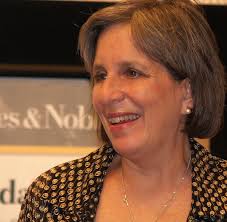
Mary Gordon and Father Daniel Berrigan

I love setting a poem or text to music. Constantly on the look-out, I read extensively. But primary to finding the right text is getting permission to use the text. Too many composers have learned the hard way, setting a contemporary text only to learn that the author or publisher will not give them permission. The piece, then, lives in a kind of limbo, waiting for the seventy years to elapse until the text is in public domain.

Locating an author is the first order of business. Over the years, I developed an uncanny ability of finding writers through a combination of sleuthing and stalking. Getting permission to use a text is usually through the publisher, but often I need to be in direct contact with the writer. Finding their contact information can be challenging. Researching them extensively at libraries or online, through universities or book reading, I snoop out addresses and phone numbers. And always, I sent them samples of my music.

In the mid 2000s I had two projects in mind, the setting of Daniel Berrigan’s poems from Uncommon Prayer for chorus, and an opera based on Mary Gordon’s wonderful novel, Pearl.  Of course, I knew neither writer, nor did I know anyone who knew them.

Mary Gordon, one of America’s most admired writers, was the easiest to track down. I quickly discovered she taught at Barnard College, and sent her a letter with a CD of some of my choral pieces and an outline of the opera project.

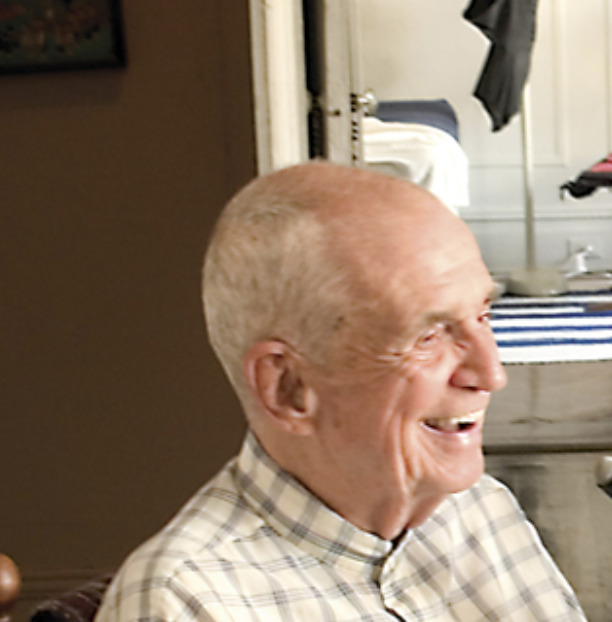
Daniel Berrigan, a Jesuit priest, peace activist, and poet best known for his commitment to a ministry that combines work among the poor with nonviolent civil disobedience, was another matter. Despite his international profile and long list of publications, he was a hard man to find. He seemed to have disappeared.

I poked around to no avail. Finally, I found his name on the Interfaith Assembly Community web site. I called the director. Yes, he knew Berrigan and had his contact information. No, he would not give it to me. I hesitated, “Would you be able to forward a letter from me to him?”  I immediately sent Berrigan a CD of my music with an attached note.

By mid-December I was on the train to NYC to visit Father Berrigan on the upper west side. His apartment was spare and airy; a crucifix hung on the wall along with colorful wall hangings. A lean man in his eighties, he was suffering from a cold. Somehow, in our conversation, I mentioned Mary Gordon. He laughed and recounted that he had, years before, received a letter from her when she was in a catholic high school. Having been discouraged by the nuns and doubting her work, she asked what he thought.  ‘Full speed ahead.  Stay with it.  You’ll be terrific.’ he wrote back.

I brought out my copy of his Uncommon Prayer, his rewriting of the Old Testament psalms, a brilliant reweaving of their themes into contemporary reflection.

 “I haven’t read them in years,” he mused. 

“Why don’t we read them out loud together,” I suggested. 

We sat side by side in the white winter light, reading his poems to each other. “When the Spirit struck us free/ we could scarcely believe it for very joy,” I read his version of Psalm 126.  “The heavens bespeak the glory of God/The firmaments ablaze, a text of his works,” Berrigan read.

The afternoon grew dark and we sat quietly with his poetry curling around us. Finally, he said, “They held up pretty well,” his face breaking into a smile.

That evening I sat on the train returning home. I was aglow with the afternoon and pressed my forehead to the cold window. My cell phone rang. Absentmindedly I put it to my ear.

“Tina,” said a woman’s voice. It was Mary Gordon. “I loved your choral piece, Antiphon to a Virgin.” It brought tears to her eyes and she had to call me.

I laughed, “I was just talking about you this afternoon.”


Listen –

Radiant, from the opera Pearl, soprano and piano: https://soundcloud.com/tina-davidson-3/pearl-radiant

The Land, from the opera Pearl, soprano, tenor and piano: https://soundcloud.com/tina-davidson-3/pearl-the-land

Filed Under: Uncategorized Tagged With: chorus, creating music, Daniel Berrigan, Mary Gordon, Tina Davidson, women composers

Footer

  • Listen on Spotify
  • Listen on SoundCloud
  • About
  • Press
  • Works
  • Blog
  • Contact
Join The Mailing List

© 2026 Tina Davidson · Photos by Nora Stultz