• Skip to main content
  • Skip to footer

Tina Davidson

Composer

  • About
    • Biography
    • Community Engagement
  • Press
    • Press
    • Interviews & Podcasts
  • Works
    • Works
    • Listen
    • Recordings
    • Publications
  • Blog
  • Contact

composing music

What is My Business?

October 5, 2022 by Tina Davidson

Katie fidgets at the piano, and looks blankly at the music. I touch her shoulder and put my pencil on the errant note. She settles down and with much stumbling and back tracking, plays the piece. We cheer together as I hand her a sheet of stickers. She pauses long, trying to decide which one pick. I know she is taking a much-needed break from focusing. Then we start up again.
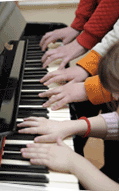
Reading music or symbols, is such a difficult process – the eyes see, the mind decodes and sends a message to the fingers, the ear hears – all the tactile, auditory, sensory abilities working together – and if one those misfires, confusion is overwhelming.

Clearly, I should say something to Katie’s parents. Her child has some sort of learning difficulty. But when I ask obliquely about how she doing in school, her mother’s face freezes. I change the subject.

In truth, it is none of my business. I am not a trained professional, and do not know what is developmental, and what is more serious. Furthermore, parents have their own path and time-table of recognizing their child’s difficulty and dealing with it.

But mostly, I don’t want to forfeit the opportunity. I have a thirty-minute window each week to spend with Katie over a few years, perhaps even as long as a ten-year-span. How can I be effective with her, or any of my students?  What do they need from me?  How do I build a confidence in them as creative, problem-solving people?

Over time, I have learned to teach to the individual rather than the music. Each is like an intricate puzzle I have to solve. I am constantly finding new ways of bending my teaching to the particular child’s mind – testing and twisting my knowledge.

I separate the reading process from the playing process, giving them difficult, fun pieces to play where the note heads are converted to letters. Their note-reading books are graphically colorful, spacious books.

I point out that speed (so well rewarded in our society) is intrinsically of little value. A completed job well done, regardless of time, is a win. I catalog, articulate and trust their abilities, reminding them occasionally that we are working together on their weaker points. I encourage them to think of alternative solutions – there is rarely one approach to a problem.
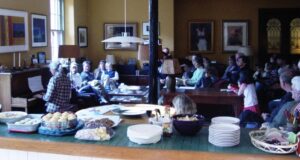
Concert given by studentsMost importantly, I give them opportunities to experience and claim their own creativity. They are constantly composing music, either at home or in their lesson, notating it as they please. And several times a year, I gather them together in informal settings to perform and celebrate their efforts.

I talk less. Give them time to solve problems without jumping in with answers. Have rests.Do lots of stickers (even for my teenagers), and work on my own patience.

Patience, patience. The child will not be baked until their mid-20’s, sometimes older. I am in it for the long run. I value the children’s excitement rather than their abilities. And I put myself constantly be in a position to say yes. Yes, yes. Why not?


Listen!  Tremble for violin, cello and piano


Filed Under: Uncategorized Tagged With: composing music, innate creativity, music by women, teaching process, Tina Davidson, women composers, writing about music

Measurable Outcomes

June 5, 2022 by Tina Davidson

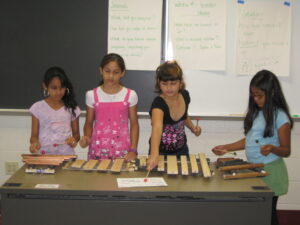
Children playing on homemade instrumentsMy three-year residency in Delaware is winding down. We sit in meetings and talk about outcomes or measurable results of my work in community settings.
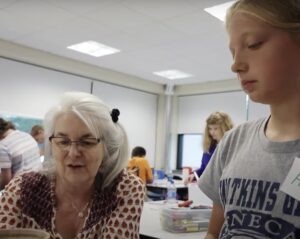
Do my students get better grades? Are the women who are homeless more successful after working with me? Or, at the very least, have we created new audiences for the arts?

These are reasonable questions. If one puts in the effort and money, shouldn’t there be tangible, visible results?

I shake my head. It is really none of my business.

I teach because I believe the power of creativity is in all of us, just unrecognized. I teachteaching because I trust it will take root in some strange and unimagined way, in its own time. I teach as an act of faith; a spiritual practice. I get up every day, and do it. “Here,” I say, “this is what I have for you today.”
I find no master-strokes or large, efficient gestures. Only this one-on-one, slow work that brings others into a meaningful connection to the arts – hopefully. A commitment to work close to the ground.


Excerpted from Let Your Heart Be Broken, Life and Music from a Classical Composer  © Tina Davidson, 2022.

Listen: Paper, String, Glass & Wood excerpt, written for professional string quartet and students quartets


Filed Under: Uncategorized Tagged With: art residencies, arts in public schools, composing music, creative process, melodic work, music by women, music residencies, process of composing, Tina Davidson, women composers

Learn to be Embarrassed

April 4, 2022 by Tina Davidson

By the time I arrived at Bennington College in 1972, I had never written a note of music. In fact, I had never played or heard any music by women composers. It never occurred to me that women could compose.

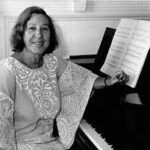
composer Vivian Fine
Vivian Fine

The music department boasted of four composers on their faculty – Louis Calabro, Vivian Fine, Lionel Nowak and Henry Brant. They believed that all performers should be composers, and all composers performers. Moreover, they eschewed the academic approach to composition that prescribed years of study of harmony and theory before you touched pencil to paper. They saw no need to waste precious class time with something you could teach yourself, and preferred to teach composition by allowing their students to write music and learn from the performance of it.

My freshman music class was taught by Lou Calabro, a loose-limbed man with slight stoop and a strong New York accent.  He was quick to give us our first assignment, to write a duet for two of our classmates. There was little instruction on how to compose. Staff paper was handed out.

I was distinctly grumpy, and muttered something about how all good music had already been written and all good composers were dead. But I wrote a piece for oboe and French horn. Twelve measures.

The piece was terrible, and the instrumentalists complained bitterly about the scattered notation and lack of dynamics. I vowed never to write for that combination again. But I was interested, and continued composing for my classmates.

By the end of my first semester, I was hooked. I knew what I wanted to do in life. It was as if, looking out into the forest, I could see many different paths, but only one was illuminated. More than that, I wanted to know who I was, and composing music was a way of finding out, without revealing too much. It was a place of investigation and almost complete anonymity.

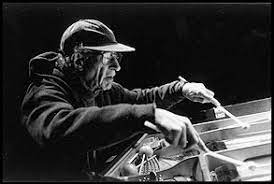
composer Henry Brant
Henry Brant

The years at Bennington passed quickly. Tuesday afternoons the entire music department gathered and played all the music composed that week. Wednesday night was the weekly concert. I studied with witty and generous Vivian Fine, a former student of Ruth Crawford Seeger, and with iconoclast Henry Brant, famous for his acoustic spatial music. He was small, brown and never without cap or sunshade on his head. Because he was opinionated and sometimes difficult to study with, I asked him to be my advisor and surreptitiously brought him my scores to look at. His rules for orchestration were brilliant; I still review his notes carefully before I begin a new orchestra piece.

As composing became my voice, piano was my anchor. My teacher, Lionel Nowak, listened intently, eyes closed, as I played. “Get into the piano keys, like clay,” he would say, lifting up his head and waving one hand. “Dig deep into them – don’t be afraid, don’t back away from anything.”

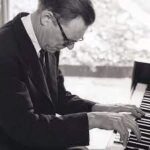
composer Lionel Nowak
Lionel Nowak

“Courage!” He sat rumpled in the chair, his right index finger raised, “You must always dare to make a fool of yourself, and then you’ll be able to do things you never dreamed you could.”

He shrugged his shoulders, “Learn to be embarrassed.”

Bennington College was, in the end, seminal in my development as a musician and composer. The faculty did not teach me how to write music, instead they invited me in joyfully and with generosity. They fostered inclusion – everyone was worthy of this particular creative process, from bright-eyed beginners to sullen veterans. They believed learning was doing, again and again.

They taught me the difference between criticism and critical thinking. The former takes a stance of superiority, the latter is respectful and self-questioning – what works or doesn’t, and how can I do better next time. They were at the heart of artistic endeavour – bold, generous, humorous, and supportive. They taught me as a fellow composer, one of their tribe.


Excerpted from Let Your Heart Be Broken, Life and Music from a Classical Composer  © Tina Davidson, 2022.

Listen: Render, for string quartet was commissioned for the Cassatt String Quartet
https://soundcloud.com/tina-davidson-3/render-2016-for-string-quartet-excerpt-2?si=2ce244ae90d64934bb8f9c02dff17e96&utm_source=clipboard&utm_medium=text&utm_campaign=social_sharing

Filed Under: Uncategorized Tagged With: composing music, creative process, creativity, original compositions, process of composing, thoughts about musical composition, Tina Davidson, women in the arts, writing about music

Have Your Babies Or Tie Your Tubes

March 7, 2022 by Tina Davidson

She steps close to me, and almost whispers, “Can you have children and still have a career in music?”

Attractive and young, she is a successful composer, already teaching at a prestigious university, and married to an older, well-known composer. They are talking about having children, but she is not sure. I smile.

I can only speak for myself. Having my daughter opened me up in a way that I never could have imagined. Through her I found the courage to face my dark self which has allowed me to speak true in my music. She awoke in me the possibility of love given and love reciprocated, and connected me to lingering soft animal embraces and the wonder of discovering the world anew. It was a second chance of unknown dimension.

And yet, time was now not my own. As a mostly single parent, I crafted careful structures for childcare, combinations of daycare and babysitters, which, at any moment could fall through – an illness, an early dismissal, a snow day – all was in shatters and I was frantic.  I’d sneak into my studio when she was playing or napping, feeling the weight of my continual distraction. She learned, implicitly, that even when I was with her, I was not always present. My gaze far off, I would put her voice on mute as I tended my evolving work, moving energy around in my thoughts.

“There is a passionate case to be made on either side, having your children or doing without, and both sides are for humanity,” says Alix Kates Shulman, in her book, Burning Questions. “Have your babies or tie your tubes – whatever you decide, you’ll find out soon enough that you’ve lost something precious.”


Excerpted from Let Your Heart Be Broken, Life and Music from a Classical Composer  © Tina Davidson, 2022.

Listen to Core of the Earth, and Lullaby, from Tina Davidson’s opera, Billy and Zelda


Filed Under: Uncategorized Tagged With: composing music, Griefs Grace, process of creating music, Tina Davidson, women artists and children, women composers, writing about music

Random Thoughts, #2

April 1, 2021 by Tina Davidson

from my music journal

September 1

Bruce Chatwin, in his book Songlines, suggests that the aboriginals sing the world into existence. Songs, or “dreaming,” are a primitive map of the world. Their natural soul describes the country in its most primary form.

February 26

I grapple with the ending of my new piece. Does the energy transform into a ‘still point,’ or is it unto itself? What is the balance between terror and wonder? What is ‘sitting-there’ energy that doesn’t change or go anywhere? I only know a deep body sense, but struggle for words.

My energy comes from a center place, and expands outwards in a kind of fullness, without grasping or overwhelming. The energy exists unto and for itself; there is no motive other than being. Like mountains, or volcanoes, like the ocean, it is guileless and full of terror. Wonder without intent. Turn away from these edifices of nature, they continue in memory, persistent, eternal. Lost or misplaced, they are there at the next turn. So simply. Just this much.

Drawing from music journal

April 16

Composer Morton Feldman reportedly said, “Most composers are limited by one form.” Finding a level of comfort, they stay with it. I wonder about mine, and wonder if I should relook at it. Press on, explore it further.

Forms or approaches are inherently archetypal. Like jewels, hidden deep in the earth, not all have been found. The work of an artist is to reveal the ones overlooked and connect us, the present us, with their magic in new ways.

July 26

Is my music an attempt to control time? Often, it is a passage or a journey, other times a documentation of now. Do I compose to control life or explain it? I have a back and forth, give and take, learning and growing relationship with my work. I dip into a sea of myself, and try to capture it in music to share with others. My work and life are fluid and I experience myself through it.

My work has a life of its own, and often insists on its own way. But it is reciprocal; as I reveal myself to my music, the music reveals myself to me. The work teaches me where to go, and what next to learn.


Excerpted from Let Your Heart Be Broken, Life and Music from a Classical Composer  © Tina Davidson, 2022.

Listen: Paper, Glass, String and Wood, for two string quartets.  III. String: 

https://www.youtube.com/watch?v=GNOBbt1EHrQ

It is My Heart Singing, music by Tina Davidson, Albany Records, TROY842, 2006

Performed by the Cassatt Quartet (Muneko Otani, Jennifer Leshnower, Tawnya Popoff, Nicole Johnson), Stephen Manes and Caroline Stinson

Purchase: https://www.amazon.com/My-Heart-Singing-Tina-Davidson/dp/B000FO443K

Filed Under: Uncategorized Tagged With: Bruce Chatwin, composing music, creativity, music journal, Tina Davidson, women

  • « Go to Previous Page
  • Page 1
  • Page 2
  • Page 3
  • Page 4

Footer

  • Listen on Spotify
  • Listen on SoundCloud
  • About
  • Press
  • Works
  • Blog
  • Contact
Join The Mailing List

© 2026 Tina Davidson · Photos by Nora Stultz