I am counting again. It comes up now and then like a nervous tick. I notice it most when I am outside walking and preoccupied with some interior thought. Suddenly I hear the sound of my counting; how many steps to my front door, how many trees line the street or how many rows of grass to mow in a section of lawn. It’s embarrassing; an obsession that keeps me from experiencing what’s around me. I sternly forbid any more counting, abstaining like an alcoholic. Soon, however, I forget to be wary and I slip back into it again, this preoccupation with the count, the soul of music.
I have long been fascinated with rhythm in my music – how to shape the energy of a piece, like a band of shimmering movement. My interest is in how it transforms, moves from one state to another, interrupts itself, then doubles back. Sometimes it is a stream of water bouncing down a curling bed, glancing off rocks and edges. Other times is it a hot liquid metal, slithering, pulsating, spurting, angry, and insistent. Whether whimsical or full of power, it is the rhythms that often take a listener to a breaking point.
But I am getting ahead of myself. First, a bit of back ground on how I understand and relate to rhythm.
Music, for me, in its crudest form is three things: organized sound, duration and silence. Sound is the pitch (high and low). Duration has to do with time, both as the invisible net in which sound floats (how long the piece is), and the length of each individual sound, or rhythm. Silence is the great back drop and rarely intrusive. It acts as a foil to contents of music, bringing it into relief.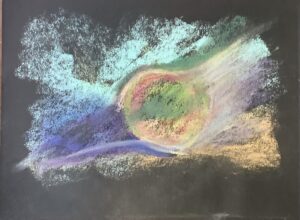
Rhythm is organized around a pulse, a steady continuous beat that hides in the background. The pulse can be fast or slow becoming the tempo or the speed of the music, but its primary role is to be the skeleton-form on which rhythm rests. For convenience, these pulses are corralled in countable units or measures, commonly 3, 4, 6 or 12. These keep the performers from flying out of place and loosing themselves completely.
The downbeat, for me, is the star of the measure. Its genesis, most likely, comes from walking. Stepping out to walk four steps, the dominate leg (usually the right leg) takes the lead, making a slightly firmer emphasis on the first step, and again on the third step. The first of these is the down beat, a natural emphasis of the measure.
Walking in groups of three is slightly different. The first group starts on the dominate leg (RLR), but the second grouping uses the nondominant leg (LRL). I almost stumble as I walk the pattern on my studio rug; the slight-off-centeredness catches my imagination.
I play with the magical insistence of downbeats. I am forever adjusting groupings of continuously running fast notes – like the sound of steady rain – not mathematically or intellectually, but in a playful, natural kind of movement.
This is where I begin. I am counting in a steady fast pace, let’s say 123 123 over and over. The first in the series is the downbeat that I feel as a little pulse. Then, wanting a change, I add them together, 123456 123456. Now the distance between downbeats is longer. Feeling a bit sassy, I put these groups together, 123 123 123456. Counting steadily, snapping my finger on each 1, I feel a lift in the last grouping, as if the 456 can’t keep their feet on the ground and are curling upwards.
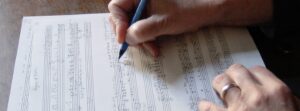 There, right there is the magic – that lift, as if you were about to fly. The upward motion pulls at gravity. I am a kayak, rushing downstream only to hit a rock. As I fly in the air, the suspension seems longer than possible; my heart stops beating for a endlessly long moment – time is distorted.
In truth, this is the way I feel my own energy. Restless and seeking, I move from one slight change to another, but always in a context that makes sense, and has an inner logic or glue. As the pressure heightens, I burst out into a calm, an arching melody of understanding perhaps. There is an interplay between the instruments, before I collect my wits about me, and dash on, back into the pulse of life.
This leads me to another question, what happens when my rhythms run out of energy? I imagine a marathon race where I am running and running. I am becoming more and more physically tired, although my pace has not changed. The moment when all my physical energy is depleted, I am unable to stand and fall towards the ground. In that vulnerable moment, I transform, and go upwards.
Isn’t it so in life? Significant change often happens when I stumble, or am so exhausted I can no longer resist. And then, the rhythm moves me upwards to what ever name I call it at the moment – God, higher power, the cosmos. I escape gravity.
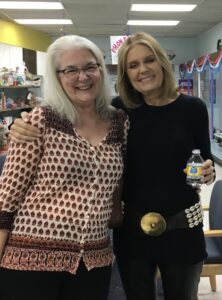 My mother was the first feminist in the family. She read Gloria Steinem, Kate Millett, Germaine Greer and Betty Friedan. She taught women’s studies and went to on countless marches. True, she often spat and lectured. A professor at the State College in Oneonta, mother of five, she knew the limits of her salary and position. She had valid grievances and was angry.
 the plates. We waited to see what emerged. Colors bloomed several days later, a brilliant white and a poisonous looking orange – a world invisible – existing only when it was allowed to grow by itself.
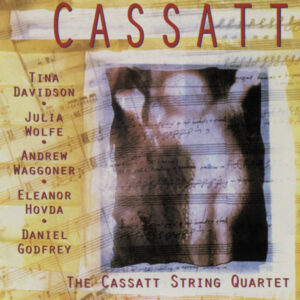 of the Greek prophetess who was never listened to or believed, and my hope for better times in the future. Women Dreaming, for mixed ensemble and piano, was my continued dreaming of possibilities. River of Love, River of Light, a seven movement choral piece, was my understanding of the female face of God.
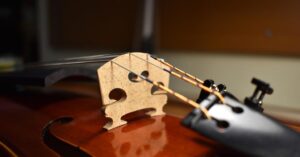 suggest. I am their supporter and collaborator. They are brilliant musicians. “Just play the music!”
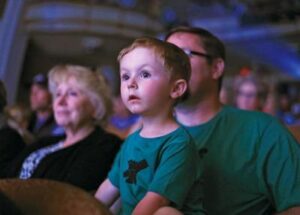 In the end, the performers collaborate with the audience – the receivers of the music. For me, it is a journey, a traveling through a sonic and emotional landscape. Because music can only experienced through time, the listener perceives the whole only with the aid of memory, a remembrance of beginning. As the performers bend over their music and the audience listens, the energy between them creates the experience.
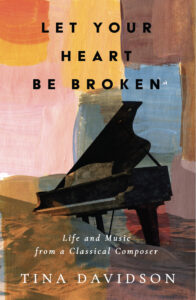 I am perplexed. Since my memoir, Let Your Heart Be Broken, has been published, I have had a couple of reviews complaining that I didn’t write about my music in a “substantive way.”
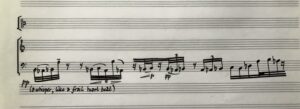 information and experience. Thus the fingers that grip the pencil over the music paper know instinctively what to do – or, at the very least, start to move towards that end. It is no longer an intellectual process for me, but an intuitive one that is very difficult to parse out, give meaning to, or even teach.
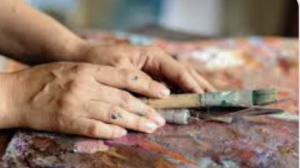 Oh! I wish could explain the mechanics of my composing process the way my art teacher tries to get me to draw realistically. I apply all the perspective and foreshortening, the color theory and the idea of value – but when she takes up my brush to show me, her brush is alive in a way that neither of us can articulate.
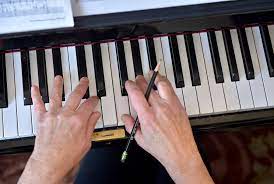 stiffening up the whole hand so it can bear the weight of the arm, or even engaging the back; soft sounds take more muscle restraint. Recently at a concert, I saw a brilliant young pianist stab the keyboard with stiffened fingers to create a percussive depth of sound, then bending her back, using loose wrists, her fingers whispered a soft rapid phrase.
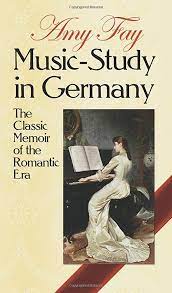 Piano technique has a long and rich history. During Bach and Mozart’s time, the keyboards were light to the touch. Performers used what was know as the “finger action” school, where the arms were relatively fixed, and the fingers skittered along. As the piano evolved with a wider range of volume, the touch became heavier. Pianists and composers such as Chopin and Liszt began to use the weight of the arm, playing with a supple wrist; this became known as the “arm weight” school of technique. I love the description that
 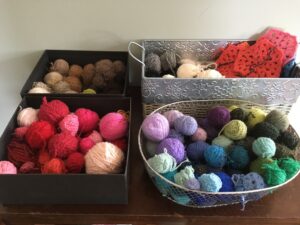 the way the yarn wound around my right index finger, slipped it in and out of clicking needles. Recently, I became fascinated with the various weights and textures of wool, and then, the consummate deliciousness of cashmere, thin, durable and much too expensive to buy. I found old cashmere sweaters at the thrift shop, and slowly undoing the side seams, I unraveled the yarn into glowing balls. I was, I confess, obsessed with the ease of this wealth of yarn and I made fingerless gloves, hats, scarves, and finally large cashmere blankets until my family begged me to stop.