• Skip to main content
  • Skip to footer

Tina Davidson

Composer

  • About
    • Biography
    • Community Engagement
  • Press
    • Press
    • Interviews & Podcasts
  • Works
    • Works
    • Listen
    • Recordings
    • Publications
  • Blog
  • Contact

arts in public schools

Measurable Outcomes

June 5, 2022 by Tina Davidson

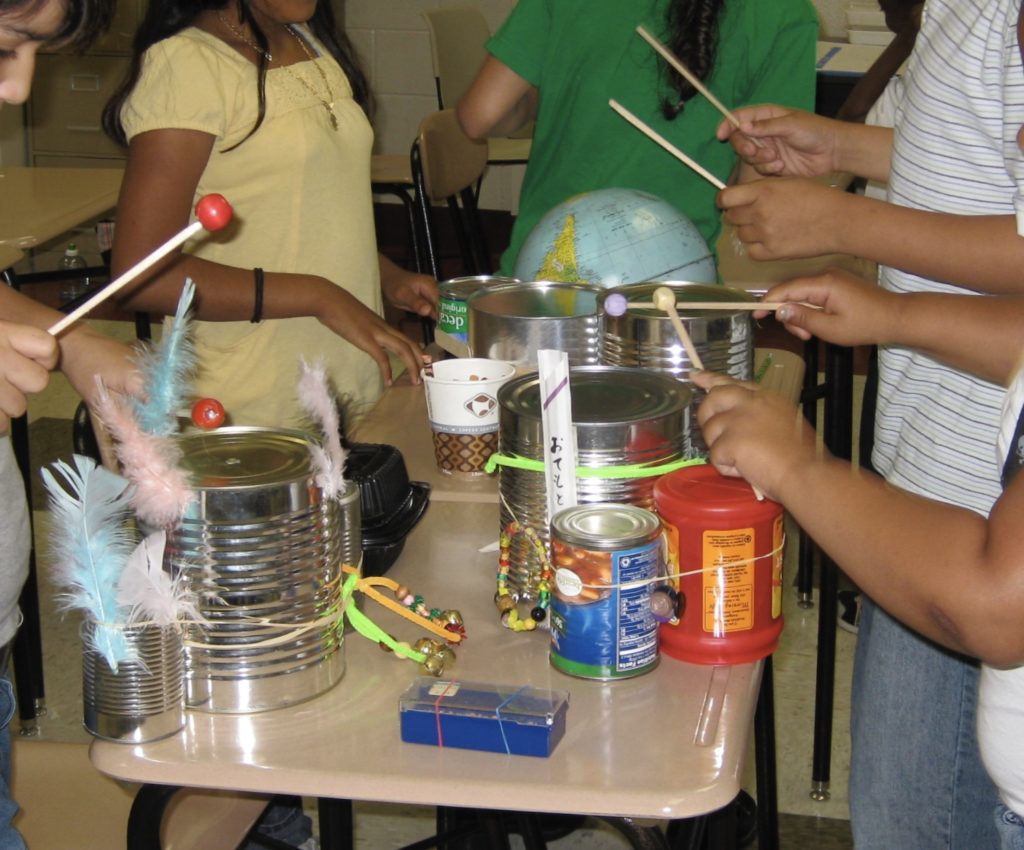
Children playing on homemade instrumentsMy three-year residency in Delaware is winding down. We sit in meetings and talk about outcomes or measurable results of my work in community settings.

Do my students get better grades? Are the women who are homeless more successful after working with me? Or, at the very least, have we created new audiences for the arts?

These are reasonable questions. If one puts in the effort and money, shouldn’t there be tangible, visible results?

I shake my head. It is really none of my business.

I teach because I believe the power of creativity is in all of us, just unrecognized. I teachteaching because I trust it will take root in some strange and unimagined way, in its own time. I teach as an act of faith; a spiritual practice. I get up every day, and do it. “Here,” I say, “this is what I have for you today.”
I find no master-strokes or large, efficient gestures. Only this one-on-one, slow work that brings others into a meaningful connection to the arts – hopefully. A commitment to work close to the ground.


Excerpted from Let Your Heart Be Broken, Life and Music from a Classical Composer  © Tina Davidson, 2022.

Listen: Paper, String, Glass & Wood excerpt, written for professional string quartet and students quartets
 

Filed Under: Uncategorized Tagged With: art residencies, arts in public schools, composing music, creative process, melodic work, music by women, music residencies, process of composing, Tina Davidson, women composers

How Will I Know When to Stop?

May 2, 2022 by Tina Davidson

Timothy stands close to me. When I move, he moves. He waits for me to play his piece with him and follows me like a shadow around the room.
I help Shante with her instrument, calm Ferron down so he can concentrate, and get sidelined by Brandi and Terrell. They work on a piece for two desks and their hands. Experimenting with fingers, palms, and fists, they make sounds on the wooden tops. I step back and almost fall over Timothy; he is patient.

Jake and Michael struggle with their invented notation. Jake’s faces contorts, he cannot figure out how to write his rhythm down. We put words to the melody, and suddenly he claps it with ease.

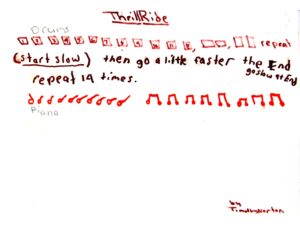
Timothy pushes me towards the piano and I grab a drum. His piece, Thrill Ride, is carefully notated in tiny print. Only he knows what it means, but he has taught me. He begins to play, his long fingers curving around the complicated chords. A dreamy look comes over his face.

“How will I know when to stop?” I press him. He continues to play, immersed in his own sound world. (McMichael Elementary School)

∗∗∗∗∗

Michael’s eyes are full of tears. His small body slumps in the chair. “It’s not fair! I want to work with the cellist.” Tears splash down his face. I study him for a moment, then settle down beside him.

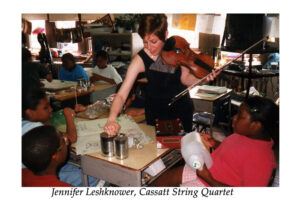
Michael and two other boys were out of the room recording the rap lyrics to the song the fifth grade class had written. During their absence, the rest of the class completed their graphically notated pieces about Homer’s Odyssey. Today, the Cassatt String Quartet joins my residency. Each group will collaborate with a member of the ensemble. The three boys have no composition. I stall, thinking.
“What if you write a new piece for all of the string players right now?” I suggest. Michael runs for the markers and newsprint. Working quickly, the boys write a piece they call Rough Riders from Lotus Town. They fight briefly about how to notate the motorcycle sound.

After a discussion, the Quartet plays the piece for the class. Michael leans into me, smiling. “They played my piece pretty good!” he concedes.  (Nebinger Elementary School)


Excerpted from Let Your Heart Be Broken, Life and Music from a Classical Composer  © Tina Davidson, 2022.

Listen:  Celestial Turnings, string orchestra: excerpt


Tina Davidson created Young Composers program to teach students to compose their own music through instrument building, graphic and invented notation. Designed to enhance self-esteem and reinforce achievement through alternative measures of expression, the course culminates with a performance of the students’ compositions.

Filed Under: Uncategorized Tagged With: arts in public schools, Cassatt Quartet, creating music, creative process, music residencies, original compositions, process of composing, students composing, Tina Davidson, women composers

Let Me Play You My Song

January 1, 2020 by Tina Davidson

Young Composer Program

I have been hired to teach my Young Composer program to fifth graders in an inner-city elementary school in Philadelphia. The school is in an economically depressed section of town and many of the kids are at risk. The music program was cut from the school curriculum several years before, but I hope they might have some of the small hand-held percussion instruments. They show me to the closet. Inside is a dusty box with a few broken xylophones.

Looking around the classroom I see garbage cans, desks and chairs; we begin a drum circle. We walk around the room with chopsticks to find the best sound in the room. We catalogue all the sounds our body can make, teeth chattering, snorts, finger snaps, and thigh slaps. One of the boys turns red as he makes a rude noise.

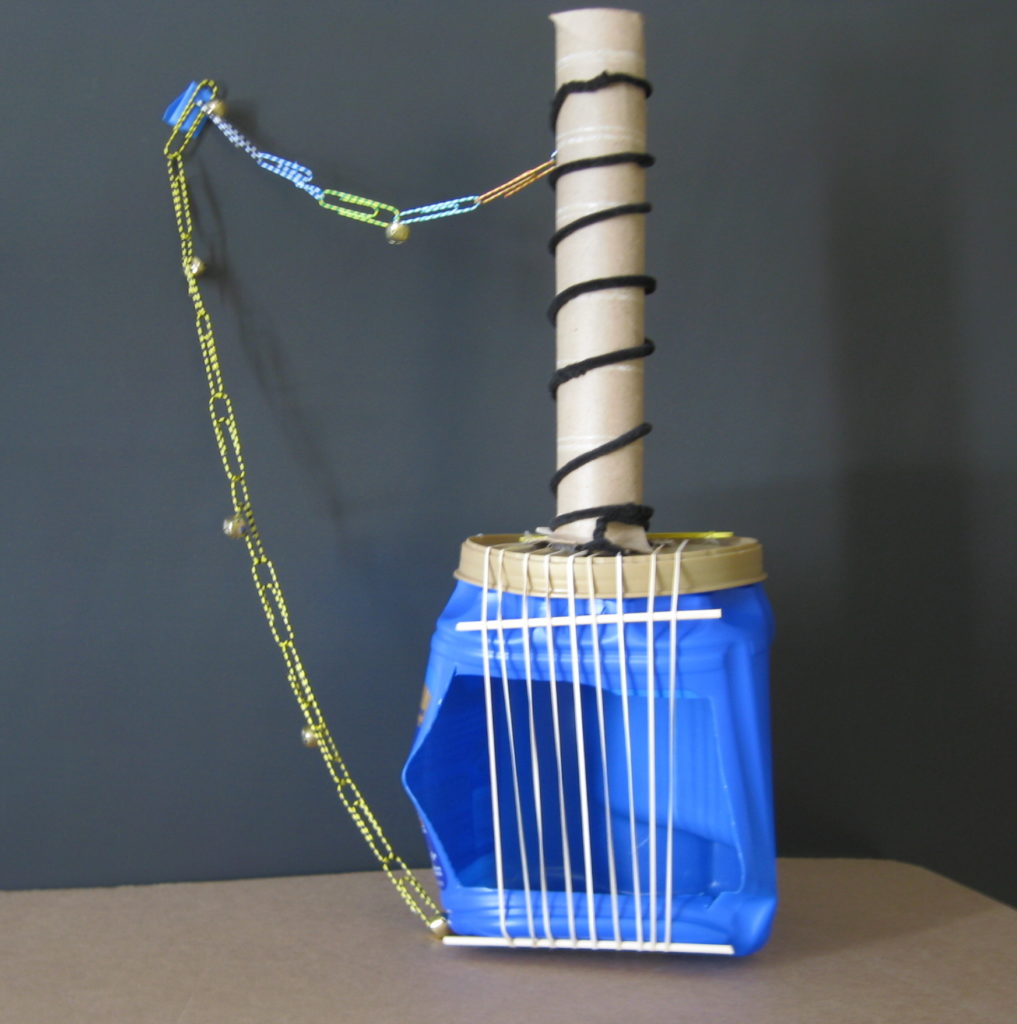
Guitar: coffee container, paper towel roll, rubber bands, paper clips

At the end of the class, I say, “Let’s make instruments!”  The kids are delighted.  “What do you have at home that you can bring in to make instruments?” I ask.

“Junk,” they yell back.

They bring what they have from their recycling bins – and a shoebox becomes a guitar, tin cans become drums, plastic soda bottles become shakers decorated with strings of beads.

Suddenly they can’t wait to write music.

Graphic Notation

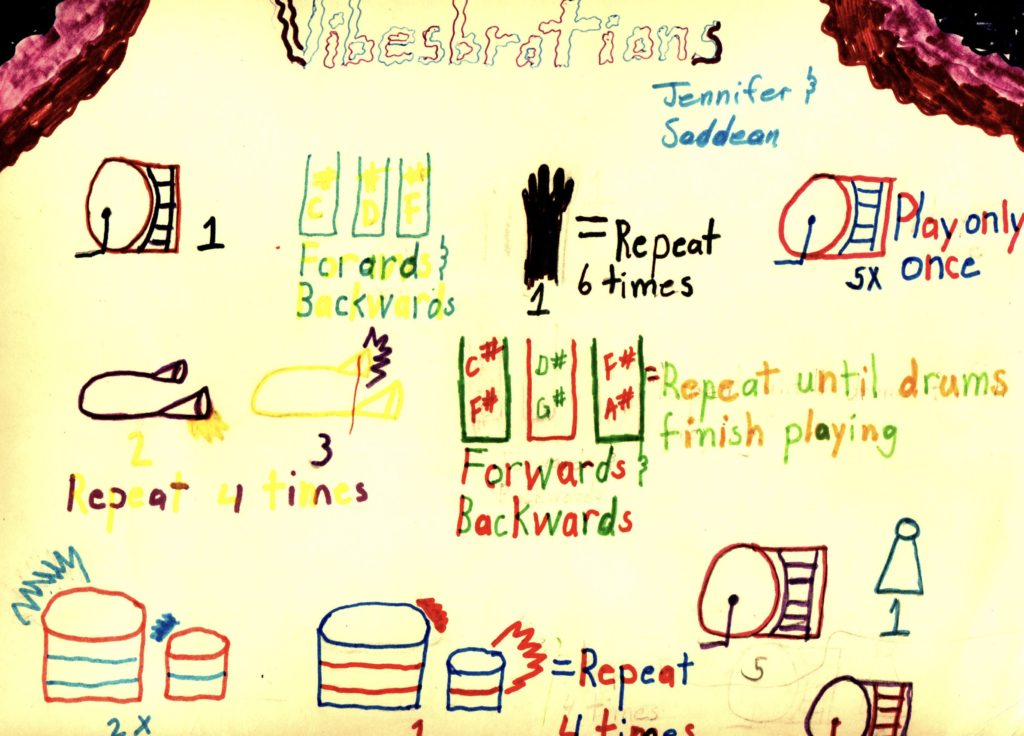
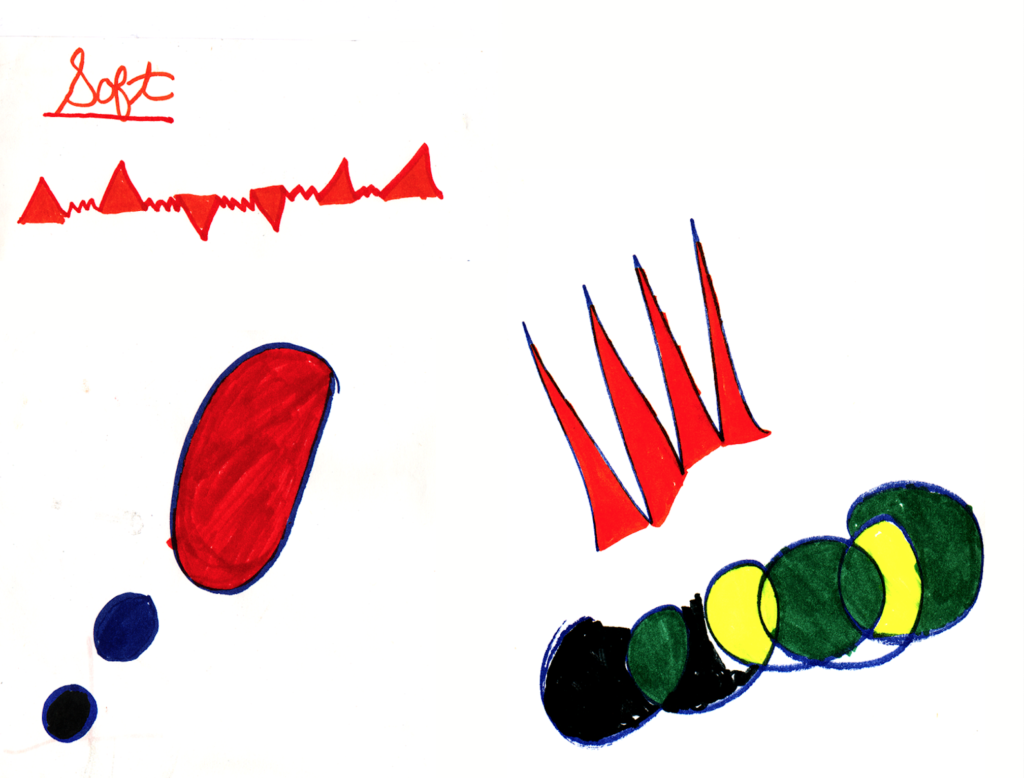
We begin with graphic notation – drawing the sound on large paper, where the shape and density of the mark indicates pitch. In groups of four, they write pieces based on a title, such as the ‘Haunted House’ or ‘The Pet Store.’ They invent notation by “drawing” the sounds they hear and then perform them with their hand- made instruments. 

Vibrations, invented notation

Then, reducing the paper, they compose with invented notation – looking at how long a sound lasted (duration), and how the sound moved up and down (pitch). They write works for more traditional instruments in pairs or individually, inventing a more exact notation as they go along. 

And always as a gift – they write pieces to share in performance with others.

Performing together

The classroom is filled with sound. Children run back and forth conferring with each other. They rehearse and revise their pieces.

I am swarmed and surrounded. They press up at me, their faces bright.

“Ms. Tina,” they tug at me, “Let me play you my song!”

YOUNG COMPOSERS PROGRAM

Tina Davidson created Young Composers program to teach students to compose their own music through instrument building, graphic and invented notation. Designed to enhance self-esteem and reinforce achievement through alternative measures of expression, the course culminates with a performance of the students’ compositions.

Filed Under: Uncategorized Tagged With: art residencies, arts in public schools, kids writing music, music residencies, original compositions, students, Tina Davidson, young composer

Footer

  • Listen on Spotify
  • Listen on SoundCloud
  • About
  • Press
  • Works
  • Blog
  • Contact
Join The Mailing List

© 2026 Tina Davidson · Photos by Nora Stultz