• Skip to main content
  • Skip to footer

Tina Davidson

Composer

  • About
    • Biography
    • Community Engagement
  • Press
    • Press
    • Interviews & Podcasts
  • Works
    • Works
    • Listen
    • Recordings
    • Publications
  • Blog
  • Contact

Uncategorized

Writers I Have Stalked

March 2, 2021 by Tina Davidson

Mary Gordon and Father Daniel Berrigan

I love setting a poem or text to music. Constantly on the look-out, I read extensively. But primary to finding the right text is getting permission to use the text. Too many composers have learned the hard way, setting a contemporary text only to learn that the author or publisher will not give them permission. The piece, then, lives in a kind of limbo, waiting for the seventy years to elapse until the text is in public domain.

Locating an author is the first order of business. Over the years, I developed an uncanny ability of finding writers through a combination of sleuthing and stalking. Getting permission to use a text is usually through the publisher, but often I need to be in direct contact with the writer. Finding their contact information can be challenging. Researching them extensively at libraries or online, through universities or book reading, I snoop out addresses and phone numbers. And always, I sent them samples of my music.

In the mid 2000s I had two projects in mind, the setting of Daniel Berrigan’s poems from Uncommon Prayer for chorus, and an opera based on Mary Gordon’s wonderful novel, Pearl.  Of course, I knew neither writer, nor did I know anyone who knew them.
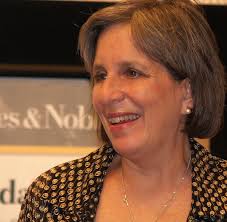
Mary Gordon, one of America’s most admired writers, was the easiest to track down. I quickly discovered she taught at Barnard College, and sent her a letter with a CD of some of my choral pieces and an outline of the opera project.

Daniel Berrigan, a Jesuit priest, peace activist, and poet best known for his commitment to a ministry that combines work among the poor with nonviolent civil disobedience, was another matter. Despite his international profile and long list of publications, he was a hard man to find. He seemed to have disappeared.

I poked around to no avail. Finally, I found his name on the Interfaith Assembly Community web site. I called the director. Yes, he knew Berrigan and had his contact information. No, he would not give it to me. I hesitated, “Would you be able to forward a letter from me to him?”  I immediately sent Berrigan a CD of my music with an attached note.

By mid-December I was on the train to NYC to visit Father Berrigan on the upper west side. His apartment was spare and airy; a crucifix hung on the wall along with colorful wall hangings. A lean man in his eighties, he was suffering from a cold. Somehow, in our conversation, I mentioned Mary Gordon. He laughed and recounted that he had, years before, received a letter from her when she was in a catholic high school. Having been discouraged by the nuns and doubting her work, she asked what he thought.  ‘Full speed ahead.  Stay with it.  You’ll be terrific.’ he wrote back.
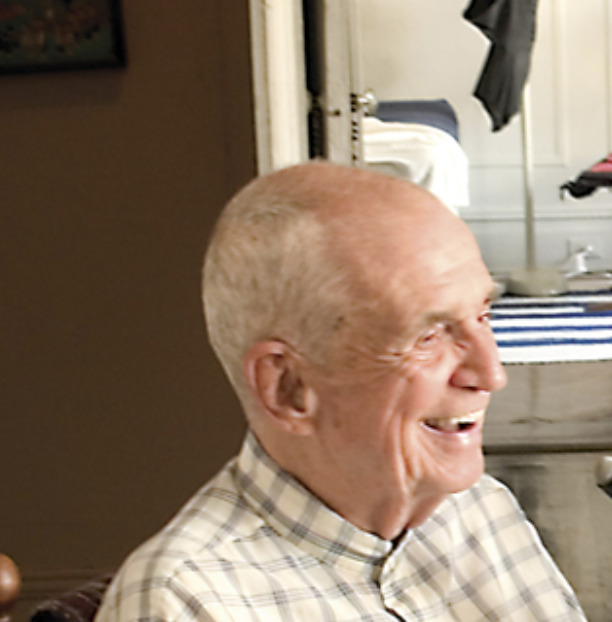
I brought out my copy of his Uncommon Prayer, his rewriting of the Old Testament psalms, a brilliant reweaving of their themes into contemporary reflection.

 “I haven’t read them in years,” he mused. 

“Why don’t we read them out loud together,” I suggested. 

We sat side by side in the white winter light, reading his poems to each other. “When the Spirit struck us free/ we could scarcely believe it for very joy,” I read his version of Psalm 126.  “The heavens bespeak the glory of God/The firmaments ablaze, a text of his works,” Berrigan read.

The afternoon grew dark and we sat quietly with his poetry curling around us. Finally, he said, “They held up pretty well,” his face breaking into a smile.

That evening I sat on the train returning home. I was aglow with the afternoon and pressed my forehead to the cold window. My cell phone rang. Absentmindedly I put it to my ear.

“Tina,” said a woman’s voice. It was Mary Gordon. “I loved your choral piece, Antiphon to a Virgin.” It brought tears to her eyes and she had to call me.

I laughed, “I was just talking about you this afternoon.”


Listen –

Radiant, from the opera Pearl, soprano and piano: https://soundcloud.com/tina-davidson-3/pearl-radiant

The Land, from the opera Pearl, soprano, tenor and piano: https://soundcloud.com/tina-davidson-3/pearl-the-land
Filed Under: Uncategorized Tagged With: chorus, creating music, Daniel Berrigan, Mary Gordon, Tina Davidson, women composers

Random Thoughts, #1

February 1, 2021 by Tina Davidson

from my music journal

August 3

A new piece of music stirs within me. I feel it in my stomach. It twists and wrenches. I know it is time to start, but I bargain for a later date. The piece quiets for a moment, then twists again. There is no real latitude in here. It pretends to placate me, but ultimately is relentless. I am relieved. Without its insistence, I am lost.

August 24

Marc Chagall wrote, “In my paintings I have hidden my love.”   Why does he hide his love? In my work, I want my love to pour out.

October 20

I am testing the difference between knowing and knowledge. Knowledge is a noun, knowing is a verb. Knowledge is permanence, an arrival to a destination, a measure of power, and a method of control; it is a command, and a grasp with expertness or skill. Knowing, on the other hand, is to perceive, sense, or see; it is to trust and listen, to hear and accept things beyond one’s imagination. Knowing is not being able to explain, but being able to expand and grow continuously. Unfixed and inexhaustible. Knowing is to be.

Fear, fear!? What is there to fear? Knowing is to recognize oneself. What is this crisis, then, this debate, this holding back?

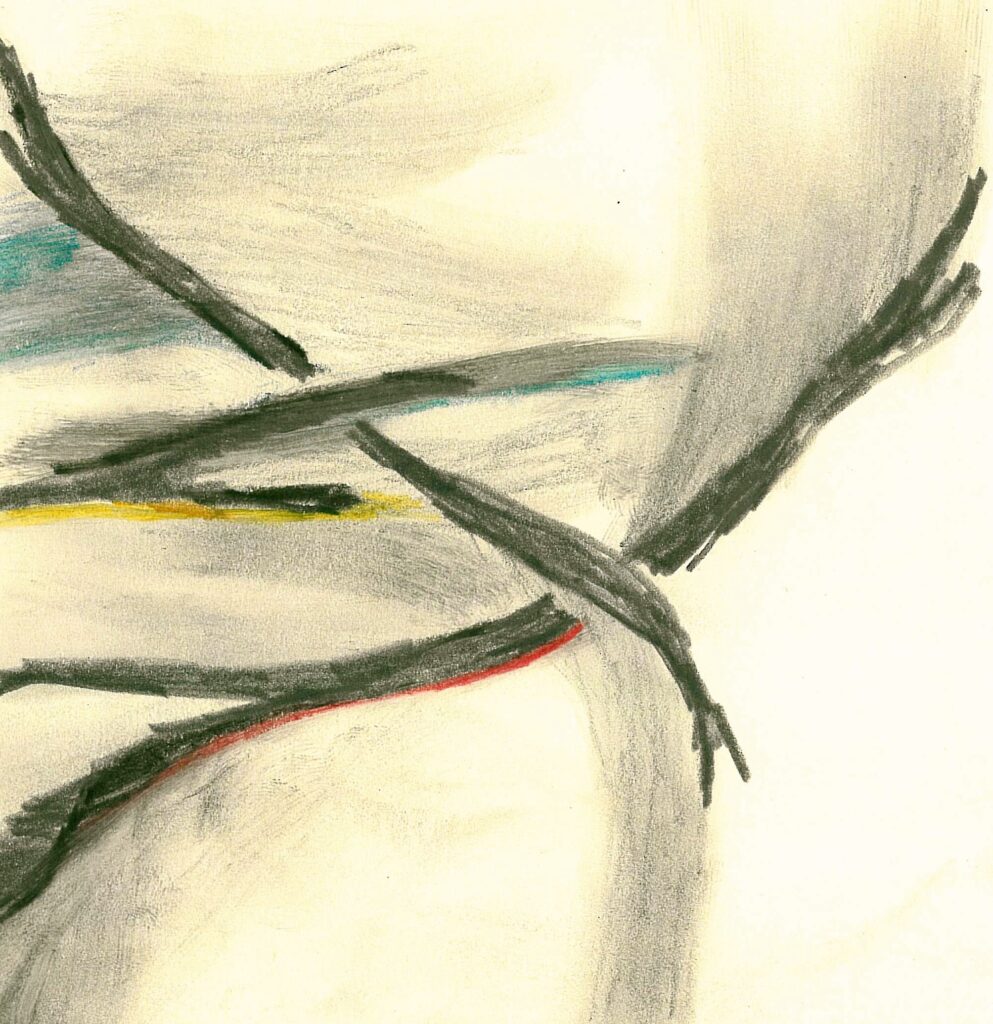
Deisis, drawing by Tina Davidson

April 3

My music is an experience, not an event. Most music is circular and contained. Mine, on the other hand, is languid and rests on its elbows like a horizon. I create a linear shape, where the music evolves, transforms, and becomes. The listener moves with the music though a passage of time, into another place. In the end, the music breaks open like an egg, its content finally revealed. The gift is the inner and outer, the private and public. The soul unveiled.


Excerpted from Grief’s Grace, A Memoir by Tina Davidson.  © Tina Davidson, 2021

Listen: Delight of Angel for string quartet: 

It is My Heart Singing, music by Tina Davidson, Albany Records, TROY842, 2006

Performed by the Cassatt Quartet (Muneko Otani, Jennifer Leshnower, Tawnya Popoff, Nicole Johnson), Stephen Manes and Caroline Stinson Purchase: https://www.amazon.com/My-Heart-Singing-Tina-Davidson/dp/B000FO443K

Filed Under: Uncategorized Tagged With: creativity, drawings by women, music by women, music journal, Tina Davidson, writing about music

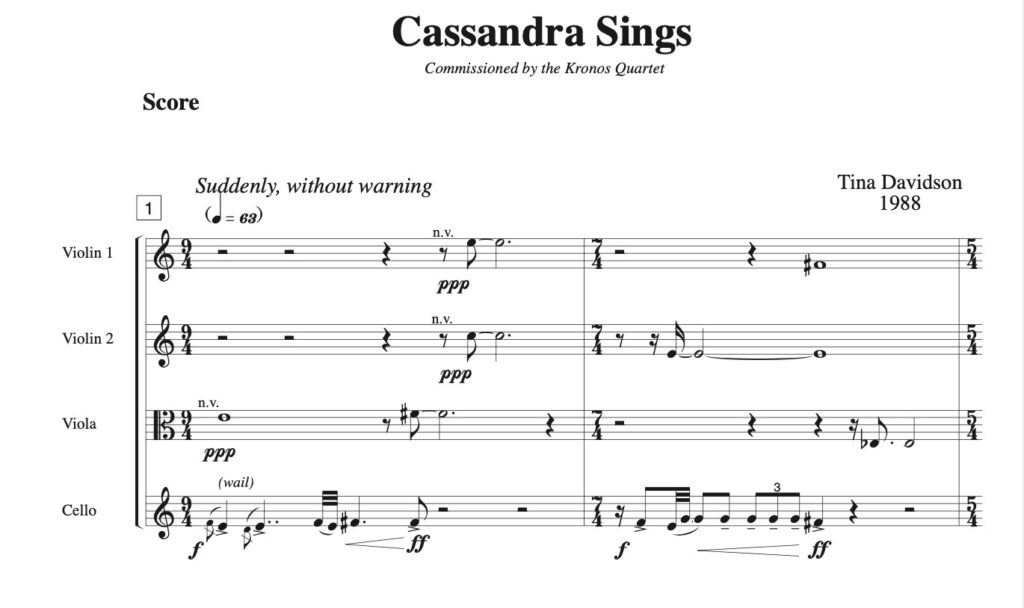
Cassandra Sings; Changing the Music

January 13, 2021 by Tina Davidson

a commissioned by the Kronos String Quartet

One day in 1988, David Harrington, first violinist of the Kronos Quartet, calls me. Weeks before, on a whim, I had sent the quartet a recording of my saxophone quintet, Transparent Victims without invitation or introduction. “We listened to your music and loved it,” Harrington says. “We want to commission you for a new string quartet – say 15-17 minutes long?”  I am astonished. 

Not long afterwards I fly down to the New Music America Festival in Miami to meet with the quartet. I hear them premiere Steve Reich’s powerful Different Trains and Eleanor Hovda’s beautiful and evocative Lemniscates. I sit and dream through their four-hour performance of Morton Feldman’s String Quartet, No. 2.

Back at home, I being to compose. I title the piece, Cassandra Sings, after the mythological Cassandra in the play Agamemnon by Aeschylus. There Cassandra ‘sings’ her lines, for she, like the chorus, speaks the truth – she sings the reality of life.

The work on the quartet is a sickening roller-coaster ride. Writing the first section is like going through a manic-depressive storm, at times ecstatic, at others agonizingly difficult. The rhythm tears along, bumping into sounds that are both unexpected and comfortable. I spin through reams of material, yet it is all connected somehow; tense, pressured, chased, inescapable, and swept away. I stitch together the fabric of the piece carefully, paying great attention to the transitions. The direction surprises the ear, and is, somehow, just right. The second section rolls out easily. Already I am at Cassandra’s true joy. My dreams are released. I soar along with my music.

I fly to San Francisco to rehearse with the Kronos Quartet. The week is black and desolate. In three days they have only rehearsed two thirds of my quartet and I have yet to hear the whole piece through. Each day they inch through a small section, making almost no progress. I am exhausted. The weather is bone cold and I take long baths.

A week later I am back with the quartet in Minneapolis. At the dress rehearsal in the Walker Art Center, they play my piece in an extraordinary manner, with every note of this difficult piece in place – except for the last two, a major third echoed an octave below. I almost laugh out loud. “What’s going on with the last two notes?” I ask.

“We felt the ending was too optimistic, so we changed them.” the first violinist, David Harrington explains.

I hold my breath and wait. They have several versions to play for me – a minor third, and dissonant second, but nothing seems right.

Finally the violist says quietly, “Let’s play the piece the way it is written.”

The performance is brilliant, and I go on stage during the applause. David leans towards me. “I withdraw the argument,” he whispers. Next week is the New York City premiere at Alice Tully Hall.


Excerpted from Grief’s Grace, A Memoir by Tina Davidson.  © Tina Davidson, 2021

Listen: Cassandra Sings, for string quartet: http://www.tinadavidson.com/works/#string-quartet-sextet

Recorded by The Cassatt String Quartet, CRI # 671, Emergency Music. Listen on Spotify:

Filed Under: Uncategorized Tagged With: creative process, creativity, kronos quartet, string quartet, Tina Davidson, women composers

Intermittent Accuracy

May 15, 2020 by Tina Davidson

Let me be honest here.

We want so to attach meaning, to understand, to pin the moment down, when it is, at best, a transitory happening. My journals, for example, are an outpouring of the difficulties and pain I feel in my life. But the pain does not possess me in the way the journals seem to indicate. I work, I compose, I care for my family; I am happy and joyous. My journals are truthful and honest, but they are only intermittently accurate.

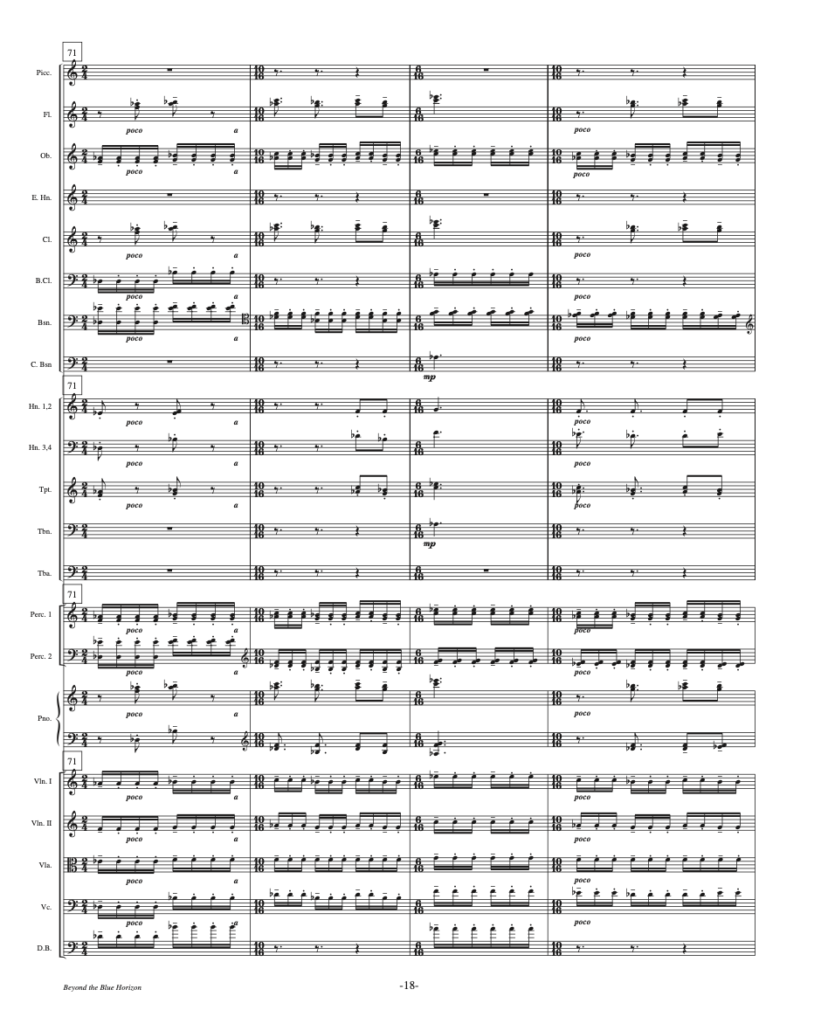
My music, which contains me, is also not accurate. There is something else, something I cannot get my tongue around. I bend forward and listen to my recent orchestra piece, trying to understand. The piece is massive and powerful, and full of feeling. I wrote it, but do not recognize myself. The work is myself in the future, the vision I have of myself and the world to come. I recognize only that it emanates from my core, and continues to a place I do not know.

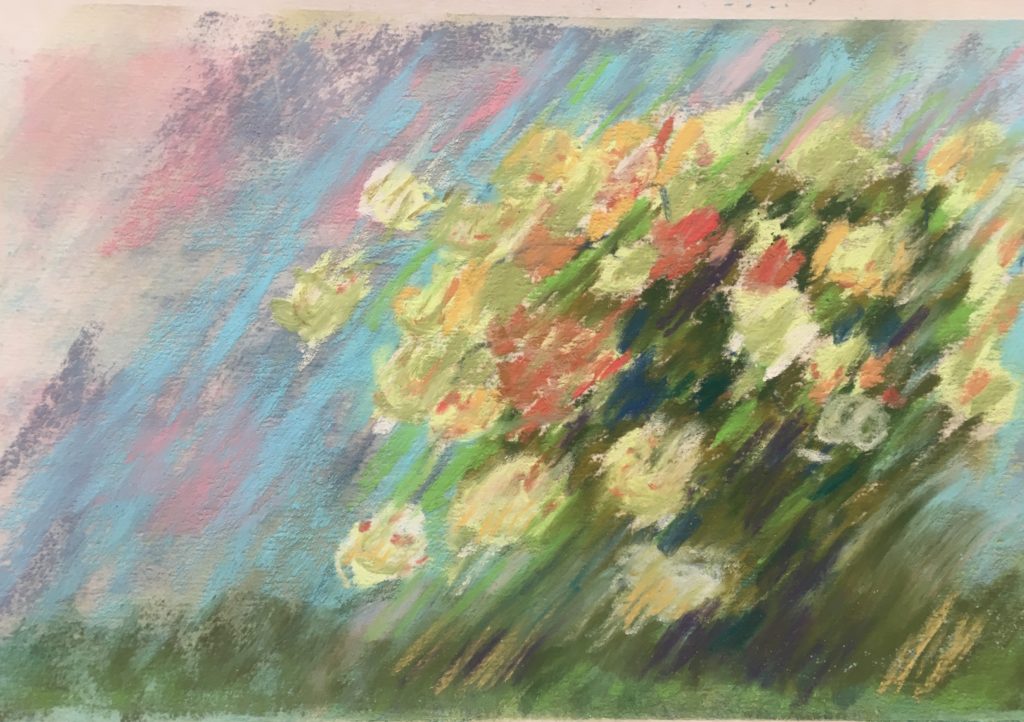
Late Summer Hydrangeas, pastel by Tina Davidson

Something happens when I compose, that for all my self-analysis and precious rethinking I have no control over. The workis larger than me, and now completed I cannot imagine how I wrote it, or even have much memory of having done so. I am not saying that something took over me and wrote the music, or that I don’t remember the content. But in the journey of composing, I go to a place that transforms the work into more than me.

Beyond the Blue Horizon, orchestra

What can it be? Second sight, intuition, a deep understanding that goes beyond the mind and ability to understand? Perhaps it is a primal knowing of the earth’s center, massive movements of the rocks, a slipping and sliding of the sun, ribbons of light. I struggle to discover myself, but this is a place I will never know with my mind. Only through my touch, my hearing – through the beating of my heart.

Listen: Render, for string quartet, Cassatt Quartet: https://soundcloud.com/tina-davidson-3/render-2016-for-string-quartet-excerpt-2

Excerpted from Grief’s Grace, A Memoir by Tina Davidson

Filed Under: Uncategorized

Dance of Creation

April 7, 2020 by Tina Davidson

Stories from teaching composition in public schools

My Young Composers are finished writing their own composition and are now preparing to perform for their school friends, teachers and parents. Because music making is a group activity, I teach them on how to work together as a team, to stay focused and attentive during the performance, and to follow the directions of the conductor. They take turns conducting each other in large group works.

Young Composers rehearsing

Sasha and Jade are the most difficult to engage. They are best friends in the worst sense. They sit together, whispering to each other or literally fall asleep at their desks. I have to wake Jade on a regular basis. Over the course of the residency, they grudgingly pretend to write a composition together. Hoping to encourage them, I ask them to come to the front of the class and play their piece for the other students. They slowly slouch forward, bumping into each other, and fuss with the music.

I wonder why I am bothering. Why don’t I ignore them altogether? But I persist.

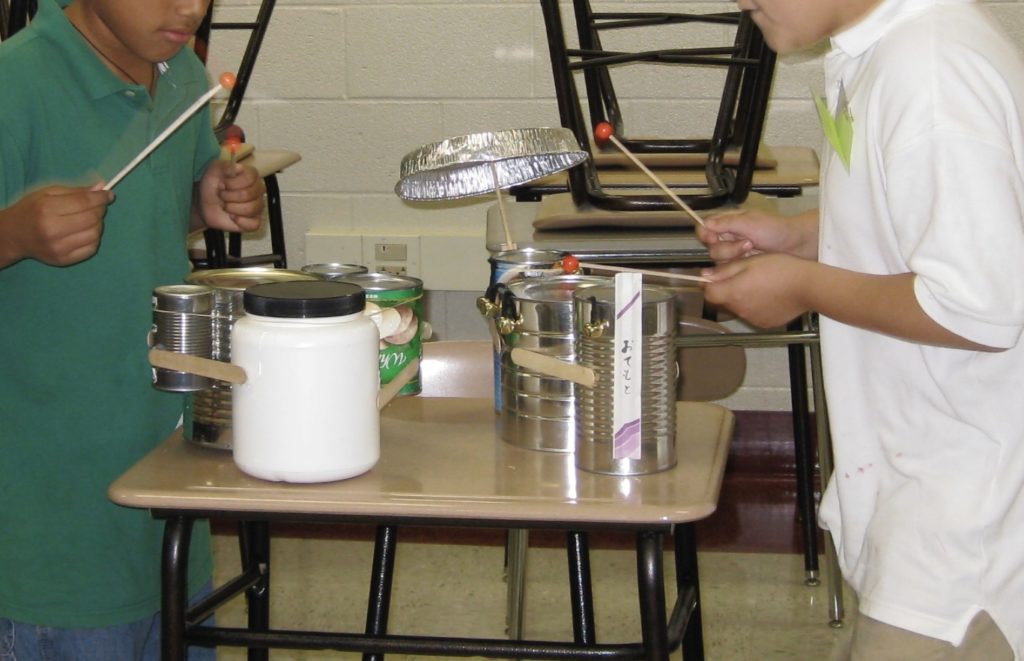
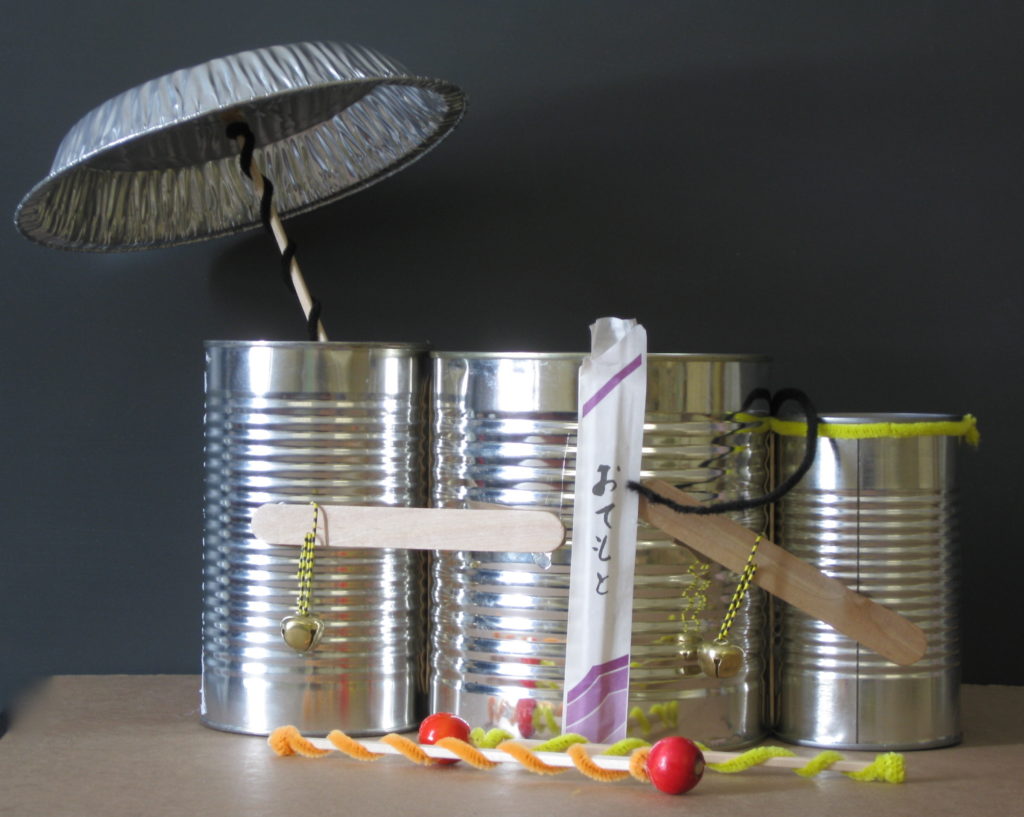
Drum Set made from tin cans and pie pan

I find I teach as much about performance as I do composition. The act of performance is complex and is a metaphor for being visible. It takes poise and maturity. These sixth graders, on the cusp of adolescence, are, frankly, a mess. They slump. They begin playing suddenly when everyone is talking. They grab their music and march off the stage before the last note is played. They burst into giggles at any hint of a mistake. 

I work patiently with each set of composers-now-performers, reminding them how to show respect for themselves, their creation and their audience.

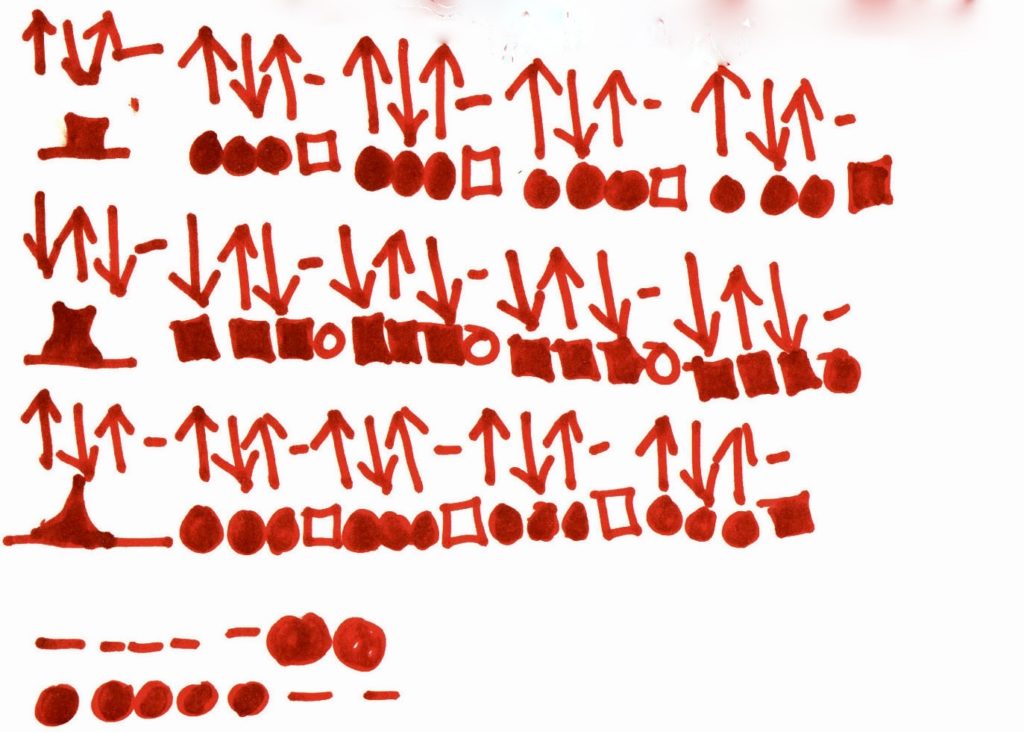
Baggin’ Beats, invented notation

Sasha and Jade are no exception. As they perform for the class they have several false starts. They get half way through the piece and grind to a halt. I drill them again and again. There is a lot of smirking as they move back to their seats. They are not going to give me an inch.

The pair drives me to distraction, but somehow, miraculously, they finish a work called Dance of Creation. At the performance they hold themselves a little bit straighter than I have ever seen them. I hold my breath, but they are fine. They perform their piece and it is all theirs.

As the applause sweeps over them, they stand there accepting the hard-won praise. Sasha’s lip curls and Jade’s face shines. They suddenly recognize their accomplishment, and I am so proud of them.

Excerpted from Grief’s Grace, A Memoir by Tina Davidson

YOUNG COMPOSERS PROGRAM

Tina Davidson created Young Composers program to teach students to compose their own music through instrument building, graphic and invented notation. Designed to enhance self-esteem and reinforce achievement through alternative measures of expression, the course culminates with a performance of the students’ compositions.

Compositions to perform with students

PAPER, GLASS, STRING & WOOD
A side-by-side work to perform with student string musicians or string orchestra. This four-movement work was created so that young or amateur musicians have the opportunity to rehearse and perform with professional string performers.  

Listen: https://soundcloud.com/tina-davidson-3/paper-from-triples-string

FIRST LIGHT
Beginning string players and string quartet or string orchestra
Created for beginning string players to perform with professional string orchestra, the work opens up with a plaintive melody for the young players. As each string section is slowly added, the work concludes with a joyous finale.

Filed Under: Uncategorized

  • « Go to Previous Page
  • Page 1
  • Interim pages omitted …
  • Page 6
  • Page 7
  • Page 8
  • Page 9
  • Page 10
  • Page 11
  • Go to Next Page »

Footer

  • Listen on Spotify
  • Listen on SoundCloud
  • About
  • Press
  • Works
  • Blog
  • Contact
Join The Mailing List

© 2026 Tina Davidson · Photos by Nora Stultz