Recently, the music notation software, Finale, long considered the industry standard, announced that it would end production. Although the software would be permanently available to download, the company would longer provide upgrades, particularly when the computer operating system changed. In other words, soon Finale would be obsolete, and most probably the music created using it would no longer be accessible.

I, like many other composers, was panicked. I had used the software for over thirty years, and almost all of my music catalogue was in Finale. I had made PDF files of all my scores for ease of printing, but any re-editing or correcting had to be done on the original file.
Finale assured composers that all was not lost; music could be migrated to another notation software system. However (why is there always a however?) this entailed a lot of re-editing. Most of the dynamics had to be reentered, glissandos were all over the place, and any unconventional notation was illegible. I was looking at hours and hours of work to upgrade each piece. The prospect was daunting at best, terrifying at worst.
Of course, I was glad I wasn’t dead. That would have been a real problem.
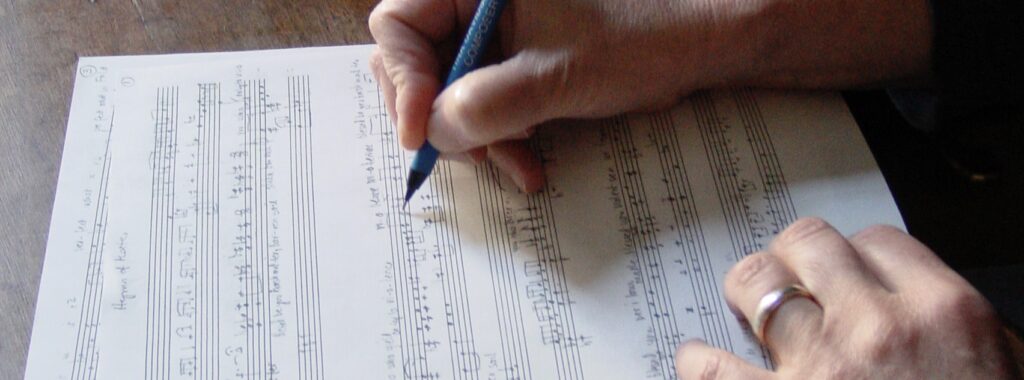
I came to age as a composer in the mid 1970’s. To create a score, I used vellum or onion skin, a durable, semi-transparent material pre-printed with a staff. Using various well chosen pens and India ink, I would copy out my music. The manuscript was then reproduced through an ozalid process.
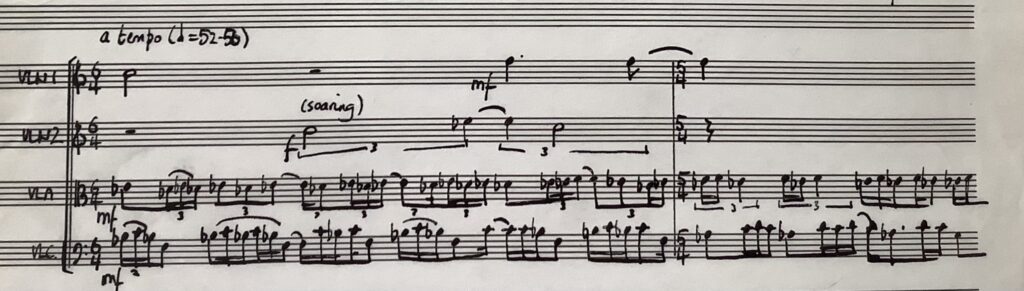
This mode of copying was time consuming. The vellum had to be dusted with talcum powder so the ink would stick. Pen nibs needed meticulously cleaning, and mistakes were scraped off or even cut out. Once the score was created, each part needed to be copied out separately on vellum. Imagine an orchestra piece with 24-28 parts; it was a proof-reading nightmare.
When photocopiers became available, I switched to handwriting the score with pen and paper. I corrected mistakes with white-out fluid, and cut a photocopied score up and glued the parts onto separate sheets of paper. The only drawback was that the parts would constantly come unglued, often falling into a tangled mess.

I began using a computer and the Finale software in 1991 with a great sigh of relief. Quickly I learned how to key in the notes, adjusting the formatting to my own personal satisfaction. My music was now more regulated and easier to read. Parts were extracted from the score and I sent them to performers by mail, or electronically as a PDF. This was a best case scenario.
The advent of music software, coupled with direct access to the world wide web has been a great equalizer for artists. Before the internet, publishers (museums or libraries) were gate keepers. They selected artists they wanted to represent and made them ‘important.’ Now, composers became their own publishers, creating websites to publicize and sell their music directly to performers. More than that, the digital age offered artists – offered me – the taste of the promise that my work would endure, some place in the big somewhere. That my work would survive and have a life beyond mine.

Artists are always concerned with the preservation of the works they have created over a life time. First, will the material used – the paper or ink – stand the test of time? Secondly, how will the works continue to get out to the public? Are there publishers who will make the music available to performing ensembles after the death of the artist? Are there libraries, museums, or archives that will store and protect the work?
We live in a time of diminishing resources to safeguard the legacy of music created by American composers. We have no national repository in the way that other countries have. Canada, for example, has a library of all its composers’ works available to view, study or perform. In other words they honor and treasure their country’s artists; the US does not. And publishers have neither the financial resources nor the interest in representing composers that are not currently successful.
The internet and the availability of music in a viable software system is of great importance; it will house, remember, preserve, and make available works of all composers – so that this generation of composers, who speak of our time, will be remembered.
The Finale-end-of-the-road reminds me of the false promise in terms of permanence. I look at my music paper with renewed fondness.
 I miss my little dog Max at the oddest times. Not when I look at his collar or his leash laid out next to my bed stand, but in the middle of the night when I absentmindedly reach up to pat the space where he used to sleep. Isabella carefully sleeps down at the bottom of the bed, out of the way of any movement.
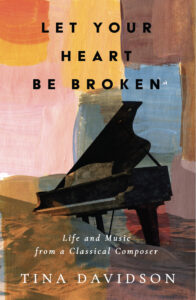 I am reading my memoir, Let Your Heart Be Broken, aloud for the audiobook. This is not an easy thing to do. I have a new respect for the muscles of the lips, mouth and cheek, and where I put my tongue to articulate a word. I am constantly dropping plurals, fumbling over words, or seeing the end of the sentence at the same time I see the beginning, and reordering the words. My engineer often raises his head from my book as he follows along with a look, and even will repeat a fugitive word for me.
 My neighbor, on the other side of the creek, cut down a slender adolescent oak I had been nurturing. In a confusion of where the property line was between our houses, the oak found itself outside of my jurisdiction. So he gleefully chopped it down, and dug up all the roots for good effect.
 I sigh and drum my pencil on the blank score paper. All morning I have been procrastinating, unable to move forward in composing my next work. I am caught in the bardo of creation – between not knowing and, at the same time, sensing the direction of the piece.
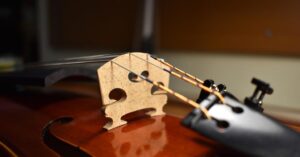
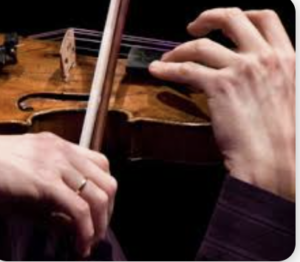 My ear is always bending towards the sound strings produce when I compose. The instrument itself is an ingenuity of construction – as one plays, the open strings resound, building up a deepening of sound – like a piano’s sustaining pedal, but discrete and selective. The resonating strings respond like ghosts to a call, building up overtones and harmonics, even different tones.
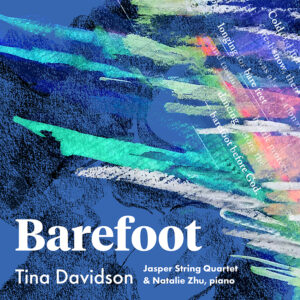 sound to a bare shadow of itself by playing with the wood of the bow) gets closer to what I experience in a single note or tone – an outer shell-like-flesh with a soft inner core.
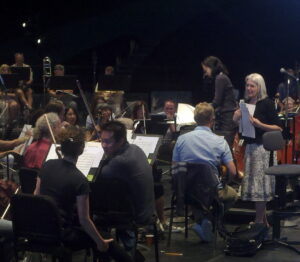 In the music world, a new piece is premiered after working with the performers in rehearsals. We confer about tempos, do a last bit of editing, talk about the musical heart of the piece and how to express it. At the performance, I introduce the work to the audience, or do a pre-concert presentation. But mostly, I am in the audience, listening. I stand for the applause, usually from my seat, or bound up to the stage for a quick bow. During the intermission and after the concert, a few audience members warmly clasp my hands. But most of them dodge around me. Did they not like my work? Or is it too vulnerable to express an opinion face to face?
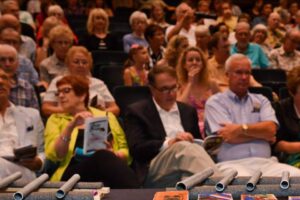 performing abilities. The works they perform are primarily historical, often hundreds years old, and referred to as masterpieces. Contemporary music – our living culture – is not performed with any regularity.
 suggest. I am their supporter and collaborator. They are brilliant musicians. “Just play the music!”
 In the end, the performers collaborate with the audience – the receivers of the music. For me, it is a journey, a traveling through a sonic and emotional landscape. Because music can only experienced through time, the listener perceives the whole only with the aid of memory, a remembrance of beginning. As the performers bend over their music and the audience listens, the energy between them creates the experience.