• Skip to main content
  • Skip to footer

Tina Davidson

Composer

  • About
    • Biography
    • Community Engagement
  • Press
    • Press
    • Interviews & Podcasts
  • Works
    • Works
    • Listen
    • Recordings
    • Publications
  • Blog
  • Contact

Composing a Life, Note by Note

Random Thoughts, #3

September 1, 2021 by Tina Davidson

from my music journal

September 28

I consider the interval of a fifth and wonder what is at the edge of sound. The fifth is a magic interval, circular and round, empty and full. It has an eerie hollowness to it. I am reminded of the soul. Without having actual form or substance, it is the heart of existence.
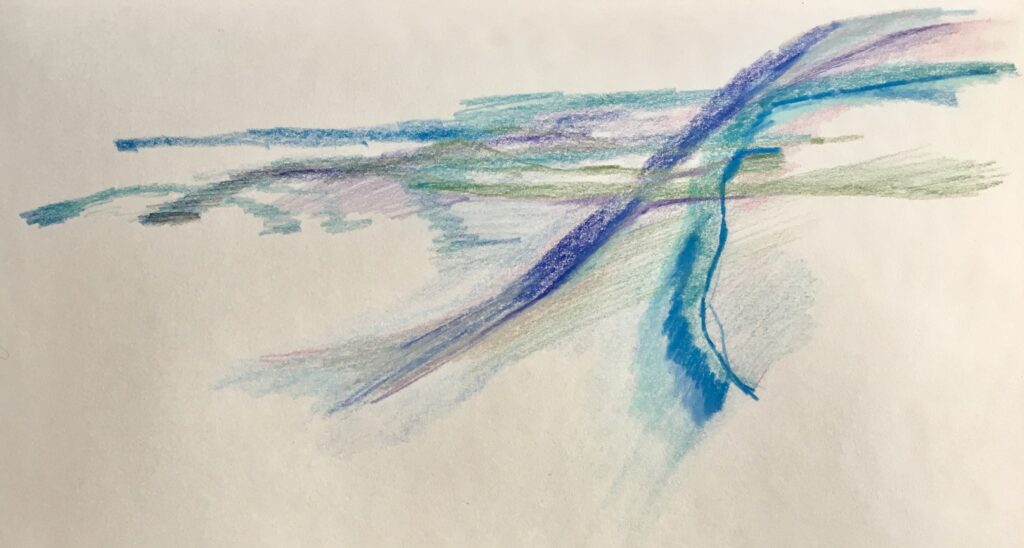
from music journal

Where does pitch begin? Where does rhythm, which is circular, start to spiral up? Must I always write in rhythms, or can I slow the upward turning? What is beauty?

October 12

“When you sing,” says Saint Augustine, “You pray twice.” Crickets chirp with candor and cars swoosh by. Sound is sacred in all its manifestations. The voice comes out of the dark, dank breath, truth warmed by my core. My vision is that we all find ourselves as the music and song.

July 7


How do I write of death and connection? The last section of the orchestra piece is clear, starting as the still point. Slowly circling, moving up, the last notes breath into an ecstasy of sound—the kind I love and can hardly bear not to write – swirling blissful love. But how do I get there? The first two thirds of the piece are blank.

The image of the laundry keeps appearing in my eye, a white dazzling continuous curl of fabric. I hear the wind rushing down the mountains, around my face, in my ears, glancing off my legs, stopping. Then picking up again. The rush of life, at its apex, almost a distortion.

December 15

My music is always my guide. The long rhythmic passages I write in most of my pieces are a marathon run of the soul, the process of surrendering to the larger unnamable whole.

At first I run light-footed, and the rhythms are enthusiastic and playful. My intellect enjoys the gait, the wind, and the smell of the earth. I begin to tire a bit, and I am absorbed in the pounding of my soles on the ground, the intricacies and overlaps. But soon my mind weakens to the muscular fatigue, and the rhythms swell.

Now there is no energy left, I can go no further. As I start to fall, there is a moment of pure supplication; my heart leaves my body and lifts upward to the divine – to the color and sound that is beyond words. There is no hesitation, no intellectual chatter, just a slow, graceful fall upward.


Excerpted from Let Your Heart Be Broken, Life and Music from a Classical Composer  © Tina Davidson, 2022.

Listen: Paper, Glass, String and Wood, for two string quartets.  I. Paper: 

https://www.youtube.com/watch?v=GNOBbt1EHrQ

It is My Heart Singing, music by Tina Davidson, Albany Records, TROY842, 2006

Performed by the Cassatt Quartet (Muneko Otani, Jennifer Leshnower, Tawnya Popoff, Nicole Johnson), Stephen Manes and Caroline Stinson

Purchase: https://www.amazon.com/My-Heart-Singing-Tina-Davidson/dp/B000FO443K

Filed Under: Uncategorized Tagged With: comsing music, music journal, thoughts about musical composition, Tina Davidson

Many are Called

May 1, 2021 by Tina Davidson

I moved to Philadelphia after graduating from Bennington College in 1976. I wanted to test the world as a composer. There was some question about how I should go about it. My brilliant and renegade Bennington teacher, Henry Brant, had no time for graduate school. “Just write music!” he practically shouted. “Write for your friends. Get it performed. Write more.” My parents, however, encourage me to think about graduate school.

My first job was at the University of Pennsylvania. Working full time, I was allowed to take two courses a semester for free. I wrangled a graduate composition class with a well-known composer. One fall afternoon, I brought in the first piece I had written after college for review, a large piece for full band that I labored over.

The eminent composer gravely considered my composition. We sat quietly, expectantly in chairs scattered around the graduate seminar room. Slowly, he turned the pages. The crisp sheets crackled. He looked without comment, and finally closed the score. Sitting back, he crossed his legs and lit a cigarette. Smoke floated and swirled around his face. “Many are called, but few are chosen,” he finally said.

We were silent; the criticism was implicit. My brain whirled frantically. “Get out of here!” it screamed. “Get away from teachers like this!”

 “Many are called, but few are chosen,” says Jesus at the end of the Parable of the Wedding Feast. What does he mean? The word ‘chosen’ implies a selection process. Jesus smiles; he is too full of love for exclusion. Well known psychiatrist and best-selling author Scott Peck deciphers it for me. “All of us are called by and to grace,” he writes, “but few of us choose to listen to the call.”

We are called, we do not listen. We have the capacity; we get sidetracked or confused. Scarcity is a false god. The world is large and full. The ability to create is a birthright. To be chosen, then, is merely to respond to the invitation. We only need believe and surround ourselves with those who say a resounding, infinite yes.

I did not complete the composition seminar that year, nor go on to graduate school. Deciding to take the advice of my teachers from Bennington College, I composed for friends and local ensembles and orchestras. Over the years, the circle widened. The National Symphony, Philadelphia Orchestra, the Kronos Quartet, The St. Paul Chamber Ensemble, and Hilary Hahn.

Showing up, I write the music.


Excerpted from Let Your Heart Be Broken, Life and Music from a Classical Composer  © Tina Davidson, 2022.

Listen: BLUE CURVE OF THE EARTH for solo violin (or violin and piano)
Commissioned by Hilary Hahn and recorded on Deutsche Grammophon in 2013 & 2018
“Grows into a lyrical world that literally seems capable of embracing the horizon. It is a shamelessly lovely piece.”  (Communities Digital News)

https://www.youtube.com/watch?v=2AaS8MkuQs8

Filed Under: Uncategorized Tagged With: Cassatt Quartet, Jesus, music journal, students composing, Tina Davidson, women in the arts, young composers

Random Thoughts, #2

April 1, 2021 by Tina Davidson

from my music journal

September 1

Bruce Chatwin, in his book Songlines, suggests that the aboriginals sing the world into existence. Songs, or “dreaming,” are a primitive map of the world. Their natural soul describes the country in its most primary form.

February 26

I grapple with the ending of my new piece. Does the energy transform into a ‘still point,’ or is it unto itself? What is the balance between terror and wonder? What is ‘sitting-there’ energy that doesn’t change or go anywhere? I only know a deep body sense, but struggle for words.

My energy comes from a center place, and expands outwards in a kind of fullness, without grasping or overwhelming. The energy exists unto and for itself; there is no motive other than being. Like mountains, or volcanoes, like the ocean, it is guileless and full of terror. Wonder without intent. Turn away from these edifices of nature, they continue in memory, persistent, eternal. Lost or misplaced, they are there at the next turn. So simply. Just this much.

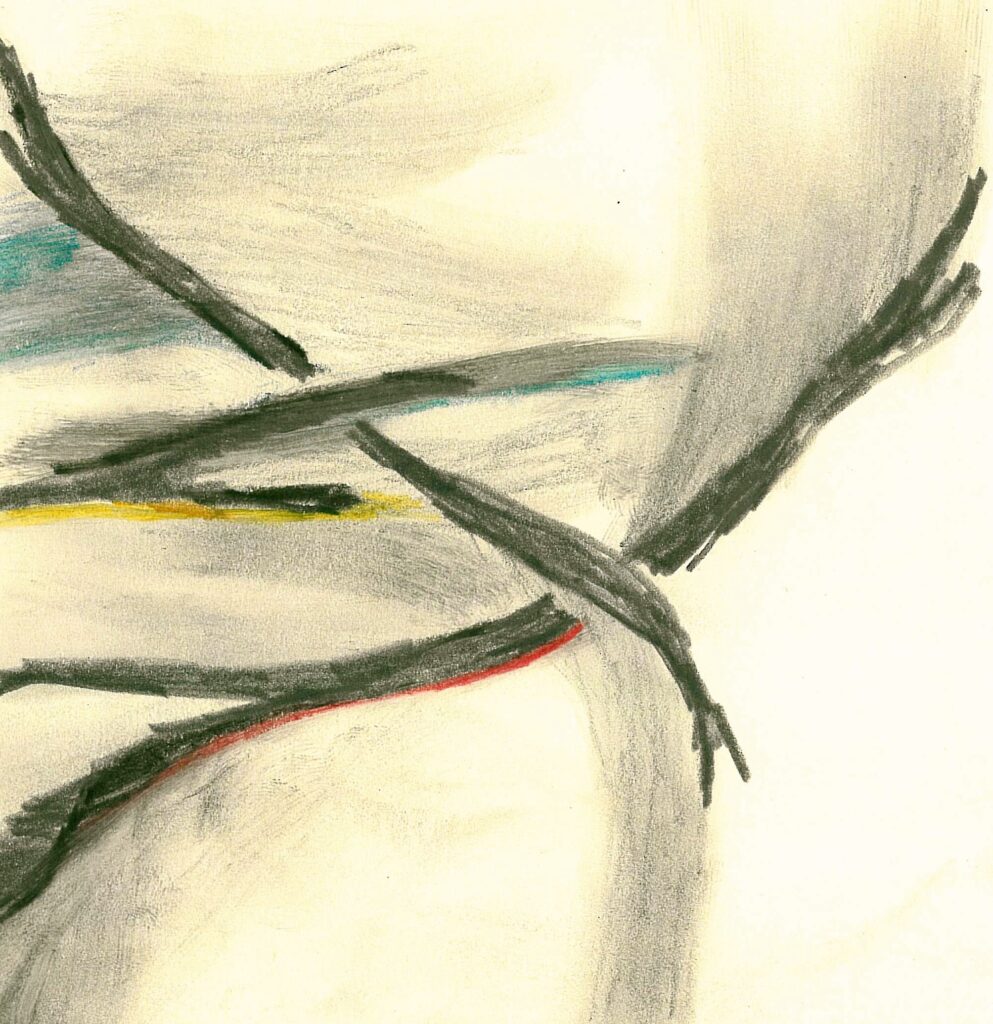
Drawing from music journal

April 16

Composer Morton Feldman reportedly said, “Most composers are limited by one form.” Finding a level of comfort, they stay with it. I wonder about mine, and wonder if I should relook at it. Press on, explore it further.

Forms or approaches are inherently archetypal. Like jewels, hidden deep in the earth, not all have been found. The work of an artist is to reveal the ones overlooked and connect us, the present us, with their magic in new ways.

July 26

Is my music an attempt to control time? Often, it is a passage or a journey, other times a documentation of now. Do I compose to control life or explain it? I have a back and forth, give and take, learning and growing relationship with my work. I dip into a sea of myself, and try to capture it in music to share with others. My work and life are fluid and I experience myself through it.

My work has a life of its own, and often insists on its own way. But it is reciprocal; as I reveal myself to my music, the music reveals myself to me. The work teaches me where to go, and what next to learn.


Excerpted from Let Your Heart Be Broken, Life and Music from a Classical Composer  © Tina Davidson, 2022.

Listen: Paper, Glass, String and Wood, for two string quartets.  III. String: 

https://www.youtube.com/watch?v=GNOBbt1EHrQ

It is My Heart Singing, music by Tina Davidson, Albany Records, TROY842, 2006

Performed by the Cassatt Quartet (Muneko Otani, Jennifer Leshnower, Tawnya Popoff, Nicole Johnson), Stephen Manes and Caroline Stinson

Purchase: https://www.amazon.com/My-Heart-Singing-Tina-Davidson/dp/B000FO443K
Filed Under: Uncategorized Tagged With: Bruce Chatwin, composing music, creativity, music journal, Tina Davidson, women

Writers I Have Stalked

March 2, 2021 by Tina Davidson

Mary Gordon and Father Daniel Berrigan

I love setting a poem or text to music. Constantly on the look-out, I read extensively. But primary to finding the right text is getting permission to use the text. Too many composers have learned the hard way, setting a contemporary text only to learn that the author or publisher will not give them permission. The piece, then, lives in a kind of limbo, waiting for the seventy years to elapse until the text is in public domain.

Locating an author is the first order of business. Over the years, I developed an uncanny ability of finding writers through a combination of sleuthing and stalking. Getting permission to use a text is usually through the publisher, but often I need to be in direct contact with the writer. Finding their contact information can be challenging. Researching them extensively at libraries or online, through universities or book reading, I snoop out addresses and phone numbers. And always, I sent them samples of my music.

In the mid 2000s I had two projects in mind, the setting of Daniel Berrigan’s poems from Uncommon Prayer for chorus, and an opera based on Mary Gordon’s wonderful novel, Pearl.  Of course, I knew neither writer, nor did I know anyone who knew them.

Mary Gordon, one of America’s most admired writers, was the easiest to track down. I quickly discovered she taught at Barnard College, and sent her a letter with a CD of some of my choral pieces and an outline of the opera project.

Daniel Berrigan, a Jesuit priest, peace activist, and poet best known for his commitment to a ministry that combines work among the poor with nonviolent civil disobedience, was another matter. Despite his international profile and long list of publications, he was a hard man to find. He seemed to have disappeared.

I poked around to no avail. Finally, I found his name on the Interfaith Assembly Community web site. I called the director. Yes, he knew Berrigan and had his contact information. No, he would not give it to me. I hesitated, “Would you be able to forward a letter from me to him?”  I immediately sent Berrigan a CD of my music with an attached note.

By mid-December I was on the train to NYC to visit Father Berrigan on the upper west side. His apartment was spare and airy; a crucifix hung on the wall along with colorful wall hangings. A lean man in his eighties, he was suffering from a cold. Somehow, in our conversation, I mentioned Mary Gordon. He laughed and recounted that he had, years before, received a letter from her when she was in a catholic high school. Having been discouraged by the nuns and doubting her work, she asked what he thought.  ‘Full speed ahead.  Stay with it.  You’ll be terrific.’ he wrote back.

I brought out my copy of his Uncommon Prayer, his rewriting of the Old Testament psalms, a brilliant reweaving of their themes into contemporary reflection.

 “I haven’t read them in years,” he mused. 

“Why don’t we read them out loud together,” I suggested. 

We sat side by side in the white winter light, reading his poems to each other. “When the Spirit struck us free/ we could scarcely believe it for very joy,” I read his version of Psalm 126.  “The heavens bespeak the glory of God/The firmaments ablaze, a text of his works,” Berrigan read.

The afternoon grew dark and we sat quietly with his poetry curling around us. Finally, he said, “They held up pretty well,” his face breaking into a smile.

That evening I sat on the train returning home. I was aglow with the afternoon and pressed my forehead to the cold window. My cell phone rang. Absentmindedly I put it to my ear.

“Tina,” said a woman’s voice. It was Mary Gordon. “I loved your choral piece, Antiphon to a Virgin.” It brought tears to her eyes and she had to call me.

I laughed, “I was just talking about you this afternoon.”


Listen –

Radiant, from the opera Pearl, soprano and piano: https://soundcloud.com/tina-davidson-3/pearl-radiant

The Land, from the opera Pearl, soprano, tenor and piano: https://soundcloud.com/tina-davidson-3/pearl-the-land

Filed Under: Uncategorized Tagged With: chorus, creating music, Daniel Berrigan, Mary Gordon, Tina Davidson, women composers

Random Thoughts, #1

February 1, 2021 by Tina Davidson

from my music journal

August 3

A new piece of music stirs within me. I feel it in my stomach. It twists and wrenches. I know it is time to start, but I bargain for a later date. The piece quiets for a moment, then twists again. There is no real latitude in here. It pretends to placate me, but ultimately is relentless. I am relieved. Without its insistence, I am lost.

August 24

Marc Chagall wrote, “In my paintings I have hidden my love.”   Why does he hide his love? In my work, I want my love to pour out.

October 20

I am testing the difference between knowing and knowledge. Knowledge is a noun, knowing is a verb. Knowledge is permanence, an arrival to a destination, a measure of power, and a method of control; it is a command, and a grasp with expertness or skill. Knowing, on the other hand, is to perceive, sense, or see; it is to trust and listen, to hear and accept things beyond one’s imagination. Knowing is not being able to explain, but being able to expand and grow continuously. Unfixed and inexhaustible. Knowing is to be.

Fear, fear!? What is there to fear? Knowing is to recognize oneself. What is this crisis, then, this debate, this holding back?

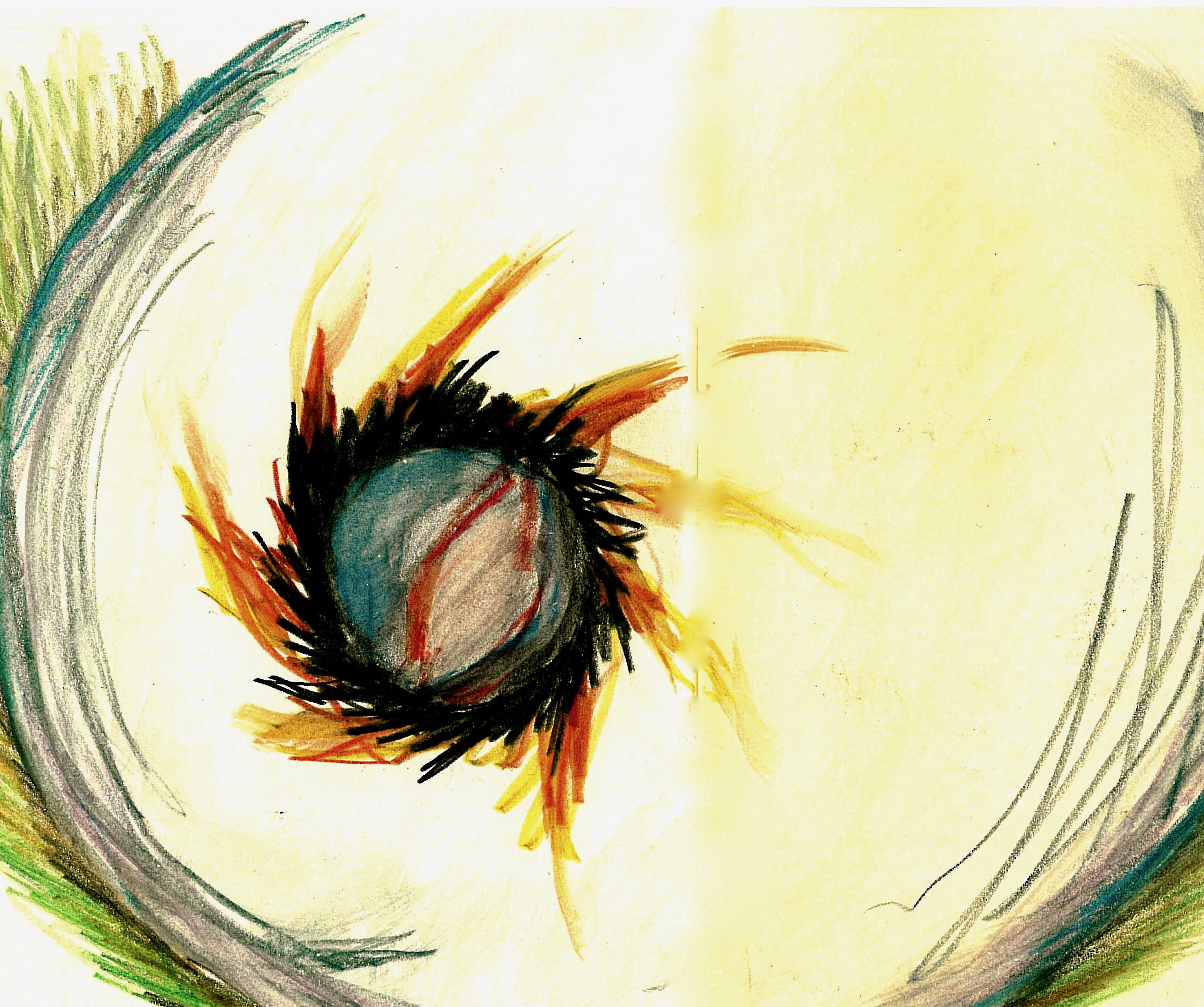
Deisis, drawing by Tina Davidson

April 3

My music is an experience, not an event. Most music is circular and contained. Mine, on the other hand, is languid and rests on its elbows like a horizon. I create a linear shape, where the music evolves, transforms, and becomes. The listener moves with the music though a passage of time, into another place. In the end, the music breaks open like an egg, its content finally revealed. The gift is the inner and outer, the private and public. The soul unveiled.


Excerpted from Grief’s Grace, A Memoir by Tina Davidson.  © Tina Davidson, 2021

Listen: Delight of Angel for string quartet: 

It is My Heart Singing, music by Tina Davidson, Albany Records, TROY842, 2006

Performed by the Cassatt Quartet (Muneko Otani, Jennifer Leshnower, Tawnya Popoff, Nicole Johnson), Stephen Manes and Caroline Stinson Purchase: https://www.amazon.com/My-Heart-Singing-Tina-Davidson/dp/B000FO443K
Filed Under: Uncategorized Tagged With: creativity, drawings by women, music by women, music journal, Tina Davidson, writing about music

  • « Go to Previous Page
  • Page 1
  • Interim pages omitted …
  • Page 7
  • Page 8
  • Page 9
  • Page 10
  • Page 11
  • Page 12
  • Go to Next Page »

Footer

  • Listen on Spotify
  • Listen on SoundCloud
  • About
  • Press
  • Works
  • Blog
  • Contact
Join The Mailing List

© 2026 Tina Davidson · Photos by Nora Stultz