• Skip to main content
  • Skip to footer

Tina Davidson

Composer

  • About
    • Biography
    • Community Engagement
  • Press
    • Press
    • Interviews & Podcasts
  • Works
    • Works
    • Listen
    • Recordings
    • Publications
  • Blog
  • Contact

Composing a Life, Note by Note

Music is Like Bread

December 4, 2023 by Nerissa

We sit, shoulder to shoulder, listening to her string quartet. Composer Jennifer Higdon is a student at the University of Pennsylvania. She comes over often to share her music or to talk. The afternoon is late, and shadows lengthen through the windows. She is dressed in a dark jacket, her face is open and smiling, framed by short black hair.

Her musical style is in the same spirit as mine, a beautiful motif appears and then recedes, ebbing and flowing as it is pushed by rhythms. We wonder out loud what relevance the standard of development has to our music. What does that word mean – develop?

I keep hearing the word ‘allow’ instead of ‘develop,’ giving the music room to fill. Is this merely about semantics, or does the argument have a deeper meaning?

In the classical music tradition, development is a process by which a composer uses the musical material of the piece. The melody and accompanying components are reworked, stretched out, condensed or changed in some fashion throughout the piece. The sonata form uses development as part of the overall structure of the piece, so that whole sections appear again, sometimes slightly modified. The idea is that the listener will anticipate the return of a melody or a section, and even understand the mu sic better because of the repetitions.

Many living composers use development as a chief technique in their music. They push the melodies around, and rework them by directly transposing or inverting them. My ear pauses. Why do I feel that they stand at the river’s edge beating their musical material with stones until it is thin, weak and colorless?

I provide the right size pan, large enough so the bread can expand to its fullest potential, and small enough so it can use the sides of the pan as support. I decide when the bread has risen enough without too much poking around. This is a judgment of my eye, heart and mind acting together. Rising too much, it will be filled with air and collapse. Rising too little, it will be mean and hard, an impenetrable nugget.

The word ‘allow’ asks for balance and helps me rethink the issue of ownership and parentage. Allow provides a medium for growth, and questions authority. Too much control forces a finger into sacred ground, leaving a trail of infection. To allow, in the end, is to have.


Featured Work

LULLABY
for solo & unspecified instrumentation (6-8)
“a gorgeously gentle piece” (St. Louis Post-Dispatch)
Listen: https://open.spotify.com/track/77Nm1qrUp6RKBRWhti8z2S

FOLLOW TINA DAVIDSON:    Facebook       Instagram

Join our Newsletter mailing list!
Email Contact

  • This field is for validation purposes and should be left unchanged.

Filed Under: Uncategorized Tagged With: Classical contemporary music, composing music, creativity, Let Your Heart Be Broken, music by women, music residencies, string quartet, writing about music

Who Names Me? (Healthy Narcissism)

November 1, 2023 by Tina Davidson

“I have wondered for a long time why it is so hard for artists — especially women — to own their status in the world,” writes artist and author, Lisa Congdon recently. “It took me years to identify confidently as an artist.  Why are we so hesitant – at least until we’ve graduated from school or until we’ve ‘made it’ — to proclaim, ‘I am an artist’?”

Sigh. The idea that it is presumptuous and pretentious to call oneself an artist has a long history. It was connected to my gender and the insistence of the music world I grew up in.

I came of age as a composer when two things were happening simultaneously. Women were testing and changing boundaries about themselves and life around them, and composers of atonal, dissonant music fought for a position in the classical music world. Just as I was looking to be included as an equal participant, they famously declared that contemporary music was above the laypeople’s ability to understand, and music, as a ‘high art form’, implied a hierarchy – who could be a composer and what kind of music one could write. Calling oneself a composer, particularly without proper pedigree, became a kind of a reverse impostor syndrome. There was no need to doubt yourself, because everyone around you was doing it so well.

And there I was, back then, naming myself – “I am a composer” without excuse or preface. It was an act of self-definition and self-creation, it was healthy narcissism.

Early on, I would spit it out, daring others to refute me. It was my mantel, my fighting clothes, instead of the more gentle “I write music.” But, by articulating my identity, I was creating a framework that allowed me to explore how I related to the world, particularly as a woman and mother. In an article for Ms Magazine (1990) I wrote how my sexuality and physicality impacted my music,

… my sexuality seems dark and powerful.  It comes out of a center place and is wide, continuous, warm, moist.  My physical energy is long and deeply rooted. It goes on and on, winding from one rhythm to another, slowly moving out, until, at its peak it is suddenly transformed into something else — a glowing, evanescencing energy.  This, for me, is not a climax, but an epiphany.  

Staking the claim, my vision became broader – I began to see more opportunities and possibilities. No longer hoping for work, I pursued it. I sent my music to performers without introduction. I became a part of a new music ensemble both as a director and performer, and wrote many pieces for them. I wrote grants, and investigated how to become more connected to community work. And always, I was on the scent of new collaborations and connections, and new works to compose.

These day, naming myself helps me deal with the ups and downs of being a life-long artist. The career of an artist takes a certain kind of exterior and interior toughness, not only a willingness to speak your truth to an audience who may or may not accept it, but also lasting through successes and failures, growth and fallow times, and career ups and downs.  But, these are, quite simply, part of being a composer. It is a package deal, and within that context of who I am, this is easier to bear.


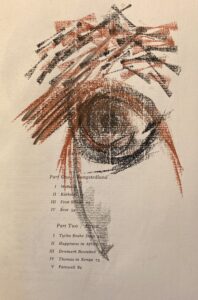
Pastel, by Tina Davidson, © 2023

Follow me!  Facebook       Instagram

ORDER Let Your Heart Be Broken, Life and Music From a Classical Composer by Tina Davidson
https://www.amazon.com/Let-Your-Heart-BrokenClassical/
dp/1633376966/?fbclid=IwAR3BU-_
UMhxivpy4A3mnPFttpYpiyLae RdD0H
HQnsVZwUjYeE7K2Lshse6M

Sign up for Davidson’s Newsletter

Email Contact

  • This field is for validation purposes and should be left unchanged.

Filed Under: Uncategorized Tagged With: composing music, I am a Composer, Let Your Heart Be Broken, music by women, Tina Davidson, writing about music

The Old Canon

October 1, 2023 by Tina Davidson

I sit across the table from him. He stands, leaning towards me, his hands grip the back of his chair. The night is gathering with birds tracing the colored clouds. “You must,” he is emphatic, “Study the history and theory of music before you begin to create your own music. Only when you know where you came from can you know where you are going.”

I smile. The old canon – a powerful system of beliefs. I have wrestled with them before, and have found, after a fifty-year career of writing music, that they are not true for me.

The canon insists that one must study the classics before creating; years of studying performance, harmony, counterpoint, set-theory, analysis and orchestration before pencil hits the paper. The canon maintains that understanding music history is an essential, and without it the artist gropes in the dark in a vain attempt to reinvent the wheel. The canon implies an order – one must do A before B. It reinforces that personal creativity is not trustworthy unless it is in an old container: it is not credible without context. In other words, one must be coupled to the past to make authentic, groundbreaking art.

I disagree, differ, object, dissent, argue, debate, and nonconcur. I protest. My experience is there are multiple paths to creativity and all of them include the word “Yes.”

I am interested in a personal ownership that grows out of doing. I support experiencing writing music before too much comparison. In the initial stage, I want everyone to compose the way they painted in kindergarten. Hardly knowing how to hold a paint brush, they work with abandon and in full confidence of their creative abilities.
Playing an instrument is key. It combines the kinetic, aural and visual learning in one practice – a kind of intimate study of music – fingering each note, breathing with the phrase – a mind-body experience.

And of course, the “guts” of music – the harmony and theory, but in context. I wonder what this study tells us about the composers of that time period, and how is it different that our own. I remind myself that the ‘great’ composers that we study, listen to and venerate have been curated by excluding much of musical culture or even composers.

But mostly, I was always on guard to protect creativity – mine and my students. I believe critical thinking rather than criticism – what worked, what didn’t work, what could I do better. This is a conversation between myself and the work, no from an outside source.

And always, always, the practice of authentic self-expression comes from digging deep into my own personal, emotional and spiritual landscape.  Where do I find myself at this stage of life?  Who am I growing into? What do I have to say next?

FOLLOW TINA DAVIDSON Facebook       Instagram

Featured Work

PAPER, GLASS, STRING & WOOD
A side-by-side work to perform with student string musicians or string orchestra

This beautiful four-movement work was created so that young or amateur musicians have the opportunity to rehearse and perform with professional string performers.
1. Paper: https://www.youtube.com/watch?v=nHfCz2qbucY
3. String: https://www.youtube.com/watch?v=GNOBbt1EHrQ
4: Wood: https://www.youtube.com/watch?v=1_XSku4IpoU

Sign up for Davidson’s Newsletter

Email Contact

  • This field is for validation purposes and should be left unchanged.

Filed Under: Uncategorized Tagged With: Authentic self-expression, creative process, creativity, Let Your Heart Be Broken, music by women, Tina Davidson, woman composer

Napping and Other Diversions

September 5, 2023 by Nerissa

I am lecturing at a local university to a hall full of music students. One of them stands and asks,  “What do you do when you hit a creative road block and can’t move forward in the work you are composing?”

I hesitate, and smile. “Take a nap!” A wave of laughter shimmered through the audience, then applause.  “No really. Take a nap, go on a walk, bake some cookies.”

There are many times in the composing process when I am at a standstill. I sit with pencil in hand, poised over the staff paper. Suddenly I find myself sorting through bills and filing letters instead. I tackle the garden, removing vines and poison ivy. My lawn, usually a tangle of clover and violets, is now in neatly mowed rows. I take long rambling walks in the woods with my little dogs. I make myself tea and stare out the window.

Ah, procrastination, I recognize you – my old nemesis! You used to make me  doubt my capacity to move forward. Now, you are signal that I am not quite ready to compose and can relax a bit. Procrastination is part of the process.

Still, progress is bumpy and halting. So finally – finally, I take a nap.

Sleep is amazing not only in its restorative power, but in it’s function to leave my brain space to do it’s work. When undistracted by my conscious clutter, my brain organizes, sorts and stores information. More importantly, it somehow simplifies the problem, sweeping away the undergrowth to make the path clearer. I wake rested, perhaps not completely ready to move forward, but on my way.

It has taken me years to develop a good creative practice, and even then it is sometimes hit or miss. I have learned be curious instead of worried, to trust my process (it has, after all, worked for over forty-five years) and to know that my mind continues working on problem while I am doing something else – and top of the list is napping. Dreaming is a special bonus.

In between times, I feed my music constantly; it is voracious. I read, journal and draw on a daily basis. I dance, garden and walk. I take ‘think weeks’ every three or four months – a week in a cabin somewhere, with my books and journals – to think and listen. And I sleep and dream, taking procrastination to bed with me.


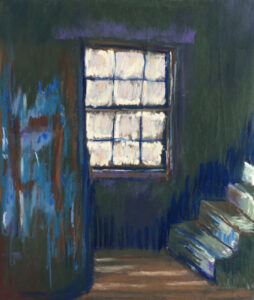
Window, pastel by Tina Davidson, © 2018

Critical Acclaim for Davidson’s memoir, Let Your Heart Be Broken“The real music here is in the words, which cascade across these pages with a gentle, precise rhythm that is reflected in Davidson’s luminous musical scores. Let Your Heart Be Broken is not the story of a solitary artist obsessed with a craft, but rather of the life that informs the art: a humanistic, worldly spirit, creating beauty amid an often-maddening yet ever-hopeful world.” 
– Broad Street Review


FOLLOW TINA DAVIDSON      Facebook       Instagram

ORDER Let Your Heart Be Broken
https://www.amazon.com/Let-Your-Heart-BrokenClassical/ dp/1633376966/?fbclid=IwAR3BU-_ UMhxivpy4A3mnPFttpYpiyLae RdD0H HQnsVZwUjYeE7K2Lshse6M

Sign up for Davidson’s Newsletter

Email Contact

  • This field is for validation purposes and should be left unchanged.


Filed Under: Uncategorized Tagged With: composing music, creative process, Let Your Heart Be Broken, music by women, process of composing, procratination, thoughts about musical composition, Tina Davidson, woman composer

My Heart is a Cello

July 20, 2023 by Tina Davidson

Of all the instruments, cello is the closest to my heart.

Growing up, I was the pianist in a household of strings. My mother was an avid amateur violinist and insisted my sisters learn to play violin and viola. I envied their ability to play with others, while I was continually alone on my own.

In college, I took up cello in addition to studying composition and piano. At times I studied with Michael Finkle, who, mustached, quirky, was full of joy. Up in a large room on the third floor of the music building we gathered weekly to play cello quartets and octets late into the evening. As a night cap, he turned off the lights and we improvised in the dark.
Soon I was transcribing Palestrina and Farkas for cello quartet. Later, I wrote a cello concerto for the wonderful Maxine Neuman, and Dark Child Sings, a cello quartet, which she recorded. And of course, many string quartets and piano trios.

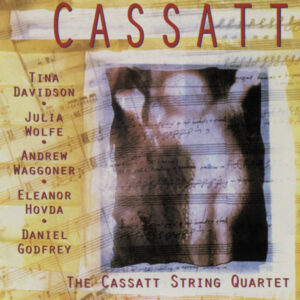
It was Anna Cholakian, the cellist of the Cassatt Quartet, who cemented my love for cello. Delicate and long-haired dark hair, she played with a intensity and passion that belied her small frame.  Listen to her play the opening of my string quartet, Cassandra Sings.

 What exactly is it about the cello that calls to me? The high notes are clear and bell-like, and the low notes have a width and groundedness to them, moist and vibrant.

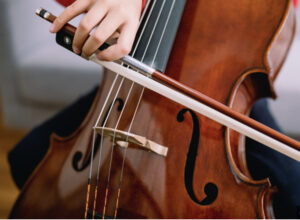
But mostly, the cello is the only classical instrument where you must open your legs and embrace the instrument to play. The broad back of the cello lightly rests against your sternum, almost touching each knee – it is a full body experience of sound. Sitting squarely, you become a tripod, a solid stance with flexibility of movement. You are the cello. You are the music.


CASSANDRA SINGS
Commissioned by the Kronos Quartet and recorded by the Cassatt String Quartet, “builds to a climax of tremendous richness, throwing out a soundscape that would seem to be much greater than merely four instruments can produce.  An extended coda achieves a resolution of sublime dimensions” (Fanfare).
https://open.spotify.com/artist/2y5Z17bEilAiViMp9FMuJh

DARK CHILD SINGS 
– lyric and rhythmic, and recorded by the Bennington Cello Quartet, New Word Records
https://soundcloud.com/tina-davidson-3/dark-child-sings-excerpt?si=e2a81e6079fc486fa1f3960fc99992ba&utm_source= clipboard&utm_medium=text&utm_campaign=social_sharing


FOLLOW TINA DAVIDSON
Facebook       Instagram

Filed Under: Uncategorized Tagged With: Cassatt Quartet, Cello, creative process, music by women, original compositions, string quartet, Tina Davidson

  • « Go to Previous Page
  • Page 1
  • Interim pages omitted …
  • Page 3
  • Page 4
  • Page 5
  • Page 6
  • Page 7
  • Interim pages omitted …
  • Page 12
  • Go to Next Page »

Footer

  • Listen on Spotify
  • Listen on SoundCloud
  • About
  • Press
  • Works
  • Blog
  • Contact
Join The Mailing List

© 2026 Tina Davidson · Photos by Nora Stultz